


Summary


The US dollar index, which measures the value of the dollar relative to a basket of currencies that belong to some of the US’ major trading partners, has rallied 18% year to date1.

The dollar’s ascent is not surprising – it is one of the few reserve currencies that offers a safe haven status and a decent yield. Nevertheless, the dollar’s run has made it increasingly expensive – the greenback is edging close to two standard deviations above its long-term average valuation. According to the Bank of International Settlements’ Real Effective Exchange Rate model, the dollar has only been more expensive on two occasions in the last 51 years. Once in 1971 near the end of the Bretton woods Agreement and the second instance was in the mid-1980’s where the dollar bubble led to the Plaza Accord.

The dollar may get even more expensive from here on the back of the US economy’s relative resilience and the Fed’s still aggressive policy tightening. The stronger than expected rise in US core inflation in September, driven by rent and transportation services, suggest that outsized rate hikes remain on the cards in the US. For the dollar to turn, it will require the Fed to reduce its pace of rate hikes, the global economic outlook to improve and investor risk appetite to rise.

The dollar’s eventual pivot matters for investors - the emerging markets (EM) have historically outperformed when the US dollar is falling, not rising. In the meantime, EM’s relatively healthy corporate balance sheets may help the region better weather the impending global slowdown. Net debt to equity ratios have fallen in recent years, making EM companies on average less leveraged than developed market companies. Interest coverage remains high, potentially providing a buffer in a world of higher interest rates. It is also interesting to note that year to date, EM currencies have on average been more resilient than the pound or euro, as the developed market currencies grapple with growth slowdowns and rising inflation, without the benefit of carry. With valuations of EM equity markets looking attractive, a weaker dollar is one of the catalysts needed for it to perform better. Therefore, investors looking to capture the longer-term potential upside in the emerging markets may want to keep an eye on when the mighty dollar turns.
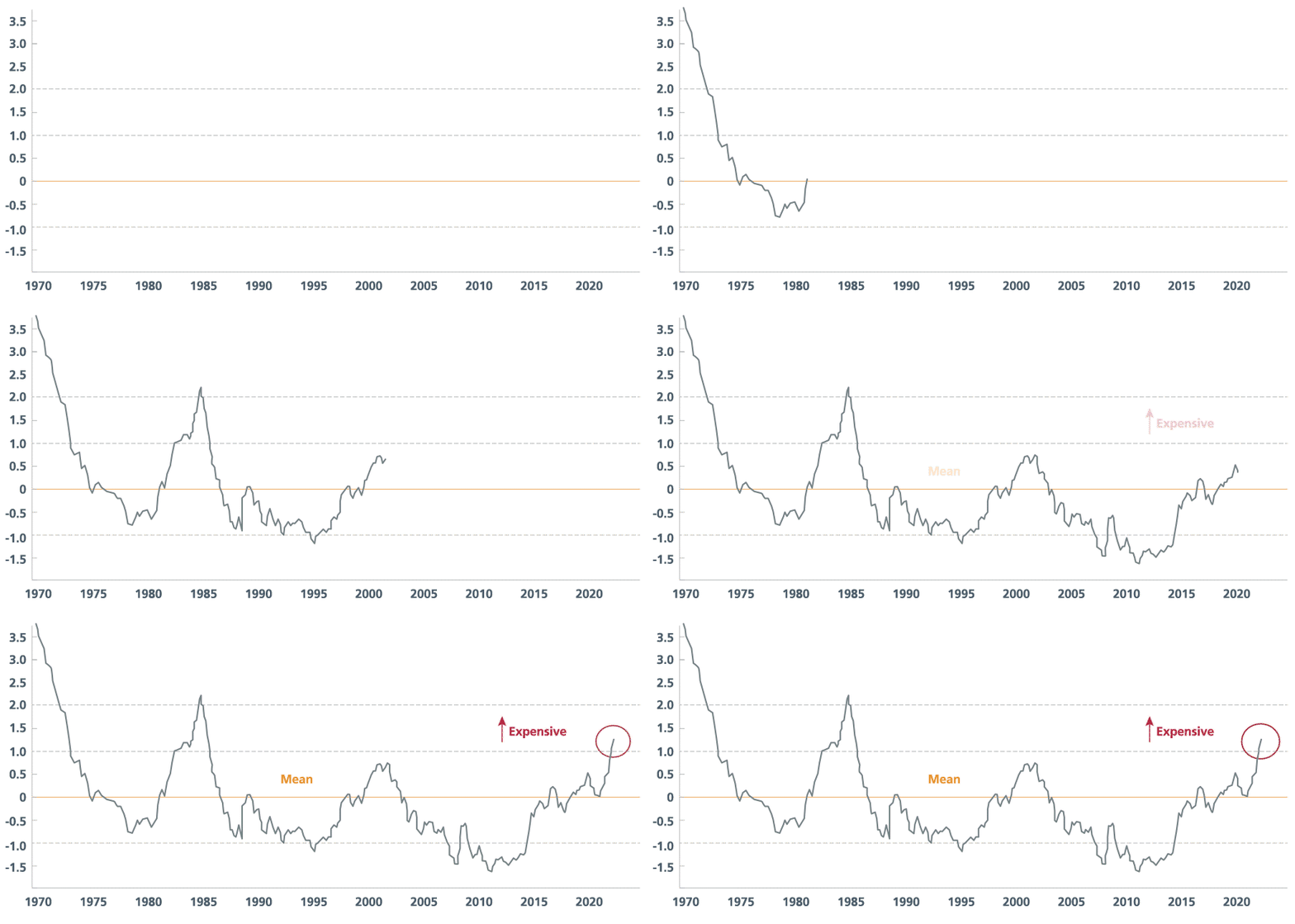

The US dollar has only been more expensive twice in the last 51 years

when-will-the-mighty-dollar-turn-fig

Source: Based on unit labour costs. Average rate from IMF and OECD, rebased to 100 in Jan 1990. Standardised.


Interesting reads

Know more
The bullish case for Emerging Markets after a decade of US exceptionalism

in insights

Equity

The bullish case for Emerging Markets after a decade of US exceptionalism

19 Feb | Steven Gray, CFA

Emerging Markets are under owned and undervalued after a decade of US equity ...

Investing tips for the Year of the Horse

in insights

Multi asset

Investing tips for the Year of the Horse

11 Feb

As we gallop into the Year of the Horse, smart investing demands true horse sense - ...

Implications of Takaichi’s historic victory

in insights

Multi asset

Implications of Takaichi’s historic victory

09 Feb

Takaichi’s landslide victory has given the LDP a rare, standalone supermajority ...

New drivers steering China equities

in insights

Equity

New drivers steering China equities

04 Feb | Jocelyn Wu

A shift to innovation, tech independence, and stronger domestic demand is redefining ...

How to get better income in Asia

in insights

Equity

How to get better income in Asia

28 Jan | Christina Woon, CFA , Rong Ren Goh

With its large number of high dividend yielding companies, a corporate culture that is ...

Q1 2026 Outlook: Near-term view for risk assets remains positive

in insights

Multi asset

Q1 2026 Outlook: Near-term view for risk assets remains positive

22 Jan

Growth in the United States and some parts of Asia are expected to be supported by ...

Asian bonds: A pathway to attractive total returns

in insights

Fixed income

Asian bonds: A pathway to attractive total returns

21 Jan | Rong Ren Goh

Asian bonds outperformed developed market bonds in 2025, supported by rate cuts, lower ...

Unscripted : Power of multi asset investing button play

in insights

Multi asset

Unscripted : Power of multi asset investing

15 Dec

For over 25 years, Eastspring’s multi asset team has navigated multiple macro cycles ...

Unscripted : Uncovering the gems in Global Emerging Markets (GEM) button play

in insights

Multi asset

Unscripted : Uncovering the gems in Global Emerging Markets (GEM)

08 Dec

In this episode of Unscripted, Salman Haider, Chief Distribution Officer Head of ASEAN ...

Sources:
1 Bloomberg. As of 17 October 2022.

This document is produced by Eastspring Investments (Singapore) Limited and issued in:

Singapore by Eastspring Investments (Singapore) Limited (UEN: 199407631H)

Australia (for wholesale clients only) by Eastspring Investments (Singapore) Limited (UEN: 199407631H), which is incorporated in Singapore, is exempt from the requirement to hold an Australian financial services licence and is licensed and regulated by the Monetary Authority of Singapore under Singapore laws which differ from Australian laws

Hong Kong by Eastspring Investments (Hong Kong) Limited and has not been reviewed by the Securities and Futures Commission of Hong Kong.

Indonesia by PT Eastspring Investments Indonesia, an investment manager that is licensed, registered and supervised by the Indonesia Financial Services Authority (OJK).

Malaysia by Eastspring Investments Berhad (200001028634/ 531241-U) and Eastspring Al-Wara’ Investments Berhad (200901017585 / 860682-K) and has not been reviewed by Securities Commission of Malaysia.

Thailand by Eastspring Asset Management (Thailand) Co., Ltd.

United States of America (for institutional clients only) by Eastspring Investments (Singapore) Limited (UEN: 199407631H), which is incorporated in Singapore and is registered with the U.S Securities and Exchange Commission as a registered investment adviser.

European Economic Area (for professional clients only) and Switzerland (for qualified investors only) by Eastspring Investments (Luxembourg) S.A., 26, Boulevard Royal, 2449 Luxembourg, Grand-Duchy of Luxembourg, registered with the Registre de Commerce et des Sociétés (Luxembourg), Register No B 173737.

Chile (for institutional clients only) by Eastspring Investments (Singapore) Limited (UEN: 199407631H), which is incorporated in Singapore and is licensed and regulated by the Monetary Authority of Singapore under Singapore laws which differ from Chilean laws.

The afore-mentioned entities are hereinafter collectively referred to as Eastspring Investments.

The views and opinions contained herein are those of the author, and may not necessarily represent views expressed or reflected in other Eastspring Investments’ communications. This document is solely for information purposes and does not have any regard to the specific investment objective, financial situation and/or particular needs of any specific persons who may receive this document. This document is not intended as an offer, a solicitation of offer or a recommendation, to deal in shares of securities or any financial instruments. It may not be published, circulated, reproduced or distributed without the prior written consent of Eastspring Investments. Reliance upon information in this document is at the sole discretion of the reader. Please carefully study the related information and/or consult your own professional adviser before investing.

Investment involves risks. Past performance of and the predictions, projections, or forecasts on the economy, securities markets or the economic trends of the markets are not necessarily indicative of the future or likely performance of Eastspring Investments or any of the funds managed by Eastspring Investments.

Information herein is believed to be reliable at time of publication. Data from third party sources may have been used in the preparation of this material and Eastspring Investments has not independently verified, validated or audited such data. Where lawfully permitted, Eastspring Investments does not warrant its completeness or accuracy and is not responsible for error of facts or opinion nor shall be liable for damages arising out of any person’s reliance upon this information. Any opinion or estimate contained in this document may subject to change without notice.

Eastspring Investments companies (excluding joint venture companies) are ultimately wholly owned/indirect subsidiaries of Prudential plc of the United Kingdom. Eastspring Investments companies (including joint venture companies) and Prudential plc are not affiliated in any manner with Prudential Financial, Inc., a company whose principal place of business is in the United States of America or with the Prudential Assurance Company Limited, a subsidiary of M&G plc (a company incorporated in the United Kingdom).