





August 2026|5 min read


Executive Summary
The software and information technology (IT) services sector has come under pressure in recent months on concerns that Artificial Intelligence (AI) could reduce demand for traditional outsourcing and development tasks. Across Asia, India appears particularly exposed given its globally competitive IT services industry, which was built on delivering large-scale, cost-effective software development and support services.
These concerns are not without merit. The sector employs around six million people and contributes roughly 8% of India's GDP, meaning any slowdown in hiring, wage growth or demand for traditional services could weigh on economic growth. In addition, industry estimates suggest AI could drive annual revenue deflation of around 2-4% in certain legacy service lines over the next two to three years.
However, we believe these concerns are overstated as AI is simultaneously creating new opportunities across IT modernisation, data architecture, cloud transformation and enterprise AI adoption. Rather than eliminating demand, AI is shifting spending towards a new generation of technology services and solutions.
Enterprise AI adoption opportunity
For India, this transition may ultimately represent a larger opportunity. While AI tools are becoming increasingly accessible, enterprises still face significant challenges in deploying AI across complex organisations. In fact, enterprise AI adoption rarely is plug-and-play.
Integrating new AI capabilities with legacy technology infrastructure, modernising data environments and ensuring AI applications deliver measurable business outcomes are all areas where established IT service providers retain a competitive advantage. This creates greater dispersion across vendors rather than a structural decline for the sector.
Some of the strongest validation comes from the frontier AI companies and hyperscalers themselves; OpenAI, Anthropic and Microsoft have collectively committed close to US$8bn this year to kickstart their own enterprise services businesses, recognising that access to AI models alone is not enough to unlock value from the technology.
Near term, however, the translation remains uncertain. Pricing pressure, competitive intensity and delayed decision-making suggest near-term growth could stay muted, which in our view keeps the debate more about timing than long-term viability.
Broader AI opportunities
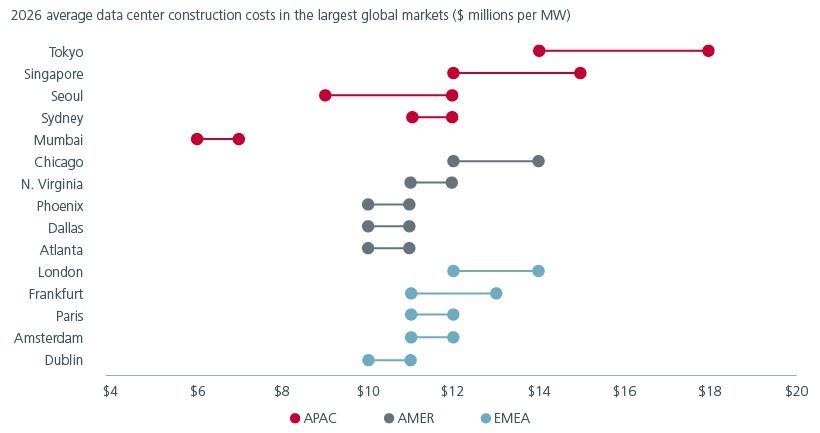
India may not be leading the race to develop frontier AI models, but it is well positioned to capture value elsewhere in the AI ecosystem. The country has become Asia's largest destination for hyperscale data centre investment, attracting more than US$100bn in commitments, supported by strong domestic demand, competitive power costs, favourable government incentives and growing interest from global technology firms seeking to diversify beyond China.
Fig 1: India is one of the most cost-competitive data centre locations globally
Source: JLL, July 2026
Importantly, India has rarely been a first mover in major technology waves, from the internet and e-commerce to smartphones and cloud computing. Yet it has repeatedly demonstrated an ability to learn and build as a latecomer. AI may follow a similar path.
Meanwhile India's start-up ecosystem is driving a new wave of innovation, expanding beyond services and consumer technology into deep-tech sectors such as AI, semiconductors, defence and space. To support this transition, the government has earmarked around US$12bn for the Research, Development & Innovation (RDI) Fund, which will be deployed over seven years from FY27 to catalyse investment across strategic industries and help foster globally competitive technology champions.
This is a very bold initiative by the govt aimed to crowd in private capital, attract talent back to India and eventually create 5 to 6 globally competitive companies in the "new ages" sectors. The unprecedented scale of this commitment underscores India's long-term ambition to move up the value chain. While the benefits may not yet be reflected in public markets, it does partly mitigate concerns around AI-driven worries at the macro level by strengthening the foundations for future innovation-led growth.
Investment implications
Market sentiment towards Indian IT remains subdued, reflecting concerns that AI-driven productivity gains could pressure traditional revenue streams. While some of these concerns are justified, we believe the debate is more nuanced than current positioning suggests.
First, revenue headwinds from AI-led deflation outweigh the emerging tailwinds over the next 2-3 years with clients actively demanding productivity passthrough. Reported sector EPS has held up reasonably well, supported by Rupee depreciation, but we believe the market is now increasingly focused on constant-currency growth as the truer measure of underlying business momentum.
Second, the competitive landscape is evolving. New entrants i.e., frontier AI labs and hyperscalers are launching their own enterprise services and AI deployment arms, opening a new front of competition for Indian IT. Incumbents retain meaningful advantages through decades-long Fortune 500 relationships and, increasingly, through partnerships with the frontier labs themselves. Even so, we expect the fear of rising competitive intensity to remain an overhang on the sector until there is more clarity on the new entrants’ playbook.
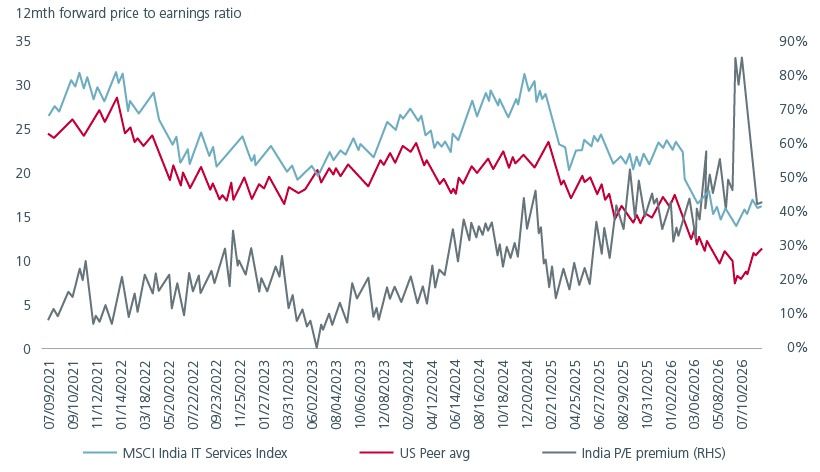
Third, valuations have yet to fully reset. Despite significant underperformance MSCI India IT has lagged MSCI India by ~19% year-to-date. Large-cap Indian IT still trades at mid-teens P/E multiples, versus low-teens multiples for US-listed peers. While India IT usually trades at a premium given domestic fund flows, the premium is above historical mean. Hence, we do not yet see a valuation floor that would justify a contrarian call or would allow us to position early for the eventual AI-driven recovery.
That said, we are not structural bears on Indian IT. India's leading IT companies have navigated multiple technology transitions over the past two decades and remain high-quality, cash-generative franchises. Consensus expectations suggest a meaningful AI-driven revenue inflection may still be two to three years away. However, equity markets typically re-rate well ahead of earnings recoveries, making valuation the key variable to monitor and, ultimately, the most likely trigger for a change in positioning.
Fig 2: India’s IT services valuation premium remains high despite recent normalisation from peak
Source: Bloomberg Aug 2026; US peers is the average between Accenture and Cognizant
Interesting reads











Singapore by Eastspring Investments (Singapore) Limited (UEN: 199407631H)
Australia (for wholesale clients only) by Eastspring Investments (Singapore) Limited (UEN: 199407631H), which is incorporated in Singapore, is exempt from the requirement to hold an Australian financial services licence and is licensed and regulated by the Monetary Authority of Singapore under Singapore laws which differ from Australian laws
Hong Kong by Eastspring Investments (Hong Kong) Limited and has not been reviewed by the Securities and Futures Commission of Hong Kong.
Indonesia by PT Eastspring Investments Indonesia, an investment manager that is licensed, registered and supervised by the Indonesia Financial Services Authority (OJK).
Malaysia by Eastspring Investments Berhad (200001028634/ 531241-U) and Eastspring Al-Wara’ Investments Berhad (200901017585 / 860682-K) and has not been reviewed by Securities Commission of Malaysia.
Thailand by Eastspring Asset Management (Thailand) Co., Ltd.
United States of America (for institutional clients only) by Eastspring Investments (Singapore) Limited (UEN: 199407631H), which is incorporated in Singapore and is registered with the U.S Securities and Exchange Commission as a registered investment adviser.
European Economic Area (for professional clients only) and Switzerland (for qualified investors only) by Eastspring Investments (Luxembourg) S.A., 26, Boulevard Royal, 2449 Luxembourg, Grand-Duchy of Luxembourg, registered with the Registre de Commerce et des Sociétés (Luxembourg), Register No B 173737.
Chile (for institutional clients only) by Eastspring Investments (Singapore) Limited (UEN: 199407631H), which is incorporated in Singapore and is licensed and regulated by the Monetary Authority of Singapore under Singapore laws which differ from Chilean laws.
The afore-mentioned entities are hereinafter collectively referred to as Eastspring Investments.
The views and opinions contained herein are those of the author, and may not necessarily represent views expressed or reflected in other Eastspring Investments’ communications. This document is solely for information purposes and does not have any regard to the specific investment objective, financial situation and/or particular needs of any specific persons who may receive this document. This document is not intended as an offer, a solicitation of offer or a recommendation, to deal in shares of securities or any financial instruments. It may not be published, circulated, reproduced or distributed without the prior written consent of Eastspring Investments. Reliance upon information in this document is at the sole discretion of the reader. Please carefully study the related information and/or consult your own professional adviser before investing.
Investment involves risks. Past performance of and the predictions, projections, or forecasts on the economy, securities markets or the economic trends of the markets are not necessarily indicative of the future or likely performance of Eastspring Investments or any of the funds managed by Eastspring Investments.
Information herein is believed to be reliable at time of publication. Data from third party sources may have been used in the preparation of this material and Eastspring Investments has not independently verified, validated or audited such data. Where lawfully permitted, Eastspring Investments does not warrant its completeness or accuracy and is not responsible for error of facts or opinion nor shall be liable for damages arising out of any person’s reliance upon this information. Any opinion or estimate contained in this document may subject to change without notice.
Eastspring Investments companies (excluding joint venture companies) are ultimately wholly owned/indirect subsidiaries of Prudential plc of the United Kingdom. Eastspring Investments companies (including joint venture companies) and Prudential plc are not affiliated in any manner with Prudential Financial, Inc., a company whose principal place of business is in the United States of America or with the Prudential Assurance Company Limited, a subsidiary of M&G plc (a company incorporated in the United Kingdom).