







Feb 2026|5 min read


Executive Summary
- Asia’s positive macro environment, strong earnings momentum and rising focus on shareholder return provide a strong and durable foundation for dividends.
- Unlike other regions, Asia’s Technology sector is a key dividend contributor, allowing high‑dividend strategies to capture both attractive income and growth opportunities.
- Asia’s dividend stocks have lower correlations with developed‑market dividend equities as well as Asian and global bonds, offering meaningful diversification for income portfolios.
Asia enters 2026 with one of the strongest income profiles globally. The region’s corporates continue to deliver the highest free cash flow yields alongside robust growth in cash flow generation globally, supporting sustainable dividends and healthier balance sheet dynamics.
Why Asia equity income now
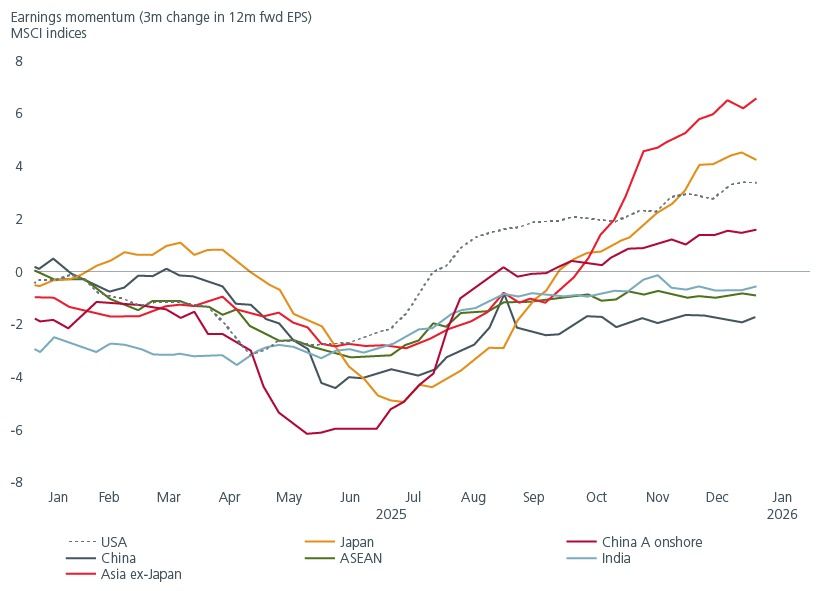
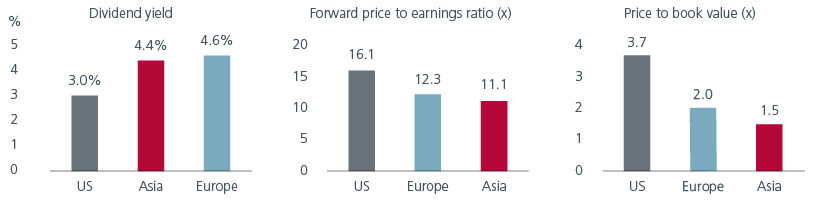
Asia’s constructive macroeconomic backdrop is underpinned by sustained investment in infrastructure and supply‑chain diversification. The global Artificial Intelligence build-out is also driving growth in the region as it results in an increased demand for Asia’s semiconductors, electronics, power generation equipment, batteries and data centres. These long‑term structural themes are translating into earnings momentum that has not been seen for more than a decade, creating a stronger and more durable foundation for dividends. Fig. 1. Meanwhile, Asia equity valuations remain compelling. Fig. 2.
Fig. 1. Asia’s earnings momentum is accelerating
Source: LSEG Datastream. January 2026.
Fig. 2. Asia has attractive dividend yield and cheaper valuations
Source: MSCI. As of December 2025. Asia: MSCI Asia Pacific High Dividend Index. US: MSCI USA High Dividend Index. Europe: MSCI Europe High Dividend Index. Developed Markets: MSCI World High Dividend Index. Past performance is not indicative of future returns.
Asia’s positive macro backdrop is reinforced by a growing emphasis on shareholder value creation across the region. In 2024, South Korean regulators put in place a Value-Up Programme designed to address the undervaluation of Korean stocks and incentivise better shareholder return policies. Since then, similar programmes have been rolled out in India, China and most recently in Singapore. The actions by Asian companies to drive better shareholder returns have been rewarded by the markets. The greater focus on shareholder returns has also led to lower dividend volatility.
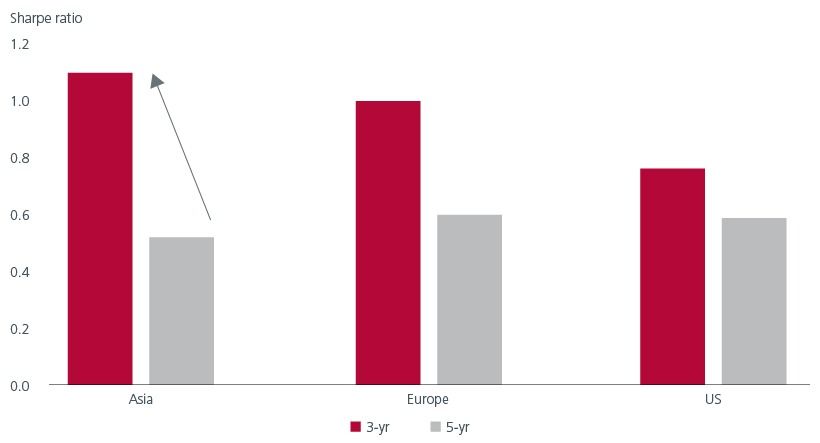
All this, coupled with lower starting valuations, has helped to lift the risk adjusted returns from Asian dividend stocks. The 3-year risk adjusted returns from Asian dividend stocks have improved significantly and are higher than the developed markets. Fig. 3.
Fig. 3. Asian dividend equities offer superior risk adjusted returns
Source: MSCI. As of December 2025. Asia: MSCI Asia Pacific High Dividend Index. US: MSCI USA High Dividend Index. Europe: MSCI Europe High Dividend Index. Developed Markets: MSCI World High Dividend Index. Past performance is not indicative of future returns.
Differentiating Asian income
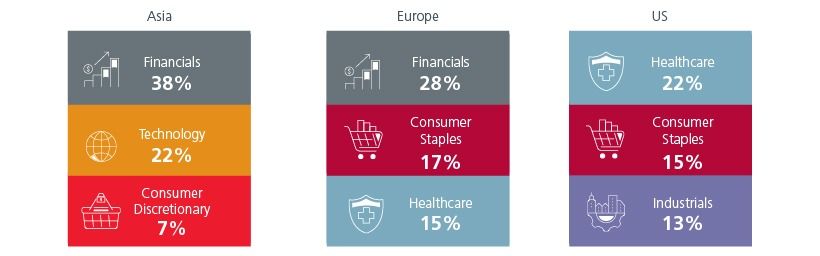
One unique factor that sets Asian dividends apart is that the Technology sector makes up a substantial share of the high dividend yield index in Asia, unlike in US and Europe, where the Consumer Staples and Healthcare sectors are more prominent. Fig. 4. As such, investors in a high dividend yielding strategy in Asia can potentially also gain some exposure to Asian tech companies and enjoy both dividends and growth.
Fig. 4. Breakdown of high dividend indices (largest 3 sectors)
Source: MSCI. As of December 2025. Asia: MSCI Asia Pacific High Dividend Index. US: MSCI USA High Dividend Index. Europe: MSCI Europe High Dividend Index. Developed Markets: MSCI World High Dividend Index. Past performance is not indicative of future returns.
It is also notable that high dividend yielding stocks in Asia have lower correlations to high dividend yielding stocks globally, as well as to global and Asian bonds. This suggests that adding Asian dividends to a global income portfolio can provide investors with greater portfolio diversification. Fig. 5.
Fig. 5. Asian dividends’ correlation with other income producing asset classes
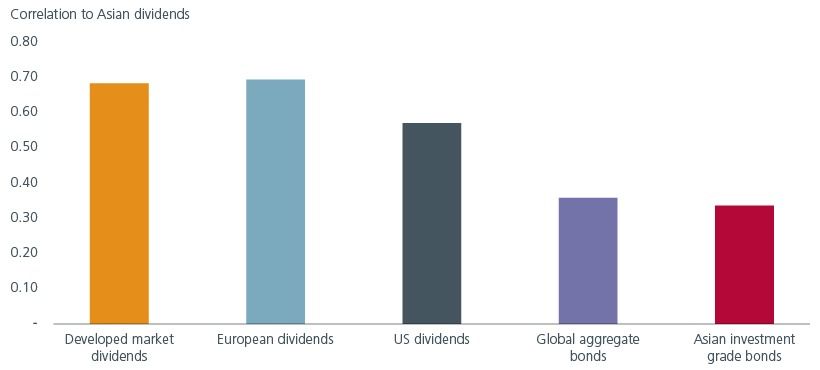
Source: Bloomberg. 10-yr correlation as of 2 February 2026. Asia dividends: MSCI Asia Pacific High Dividend Index. US dividends: MSCI USA High Dividend Index. Europe dividends: MSCI Europe High Dividend Index. Developed Market dividends: MSCI World High Dividend Index. Global aggregate bonds: Bloomberg Global Aggregate Total Return Index. Asian investment grade bonds: JACI Investment Grade Total Return Index. Past performance is not indicative of future returns.
The diversity of dividend payout ratios and yields across Asian countries and sectors creates a rich opportunity set, but we believe that an active approach is needed to fully capture its potential while managing downside risks. Deep fundamental research can help to identify emerging income opportunities linked to structural trends or cyclical sector recoveries. It can also help to seek out opportunities potentially missed by passive or screen‑based strategies. This includes companies that do not currently feature on traditional dividend screens but are approaching an inflection point where they may resume dividend payments, as well as companies which have the necessary conditions and capacity to deliver special dividends.
Equally important, we believe that rigorous bottom‑up analysis can proactively help to identify risks to dividend sustainability, which may arise from deteriorating fundamentals, industry disruption or regulatory change. This would facilitate a reallocation of capital from names where dividend risk is rising into higher‑quality opportunities. Active managers can also deliver incremental income through innovative strategies such as making use of covered calls - writing single‑stock options over existing holdings to generate additional income.
Closing the underweight to Asian income
For income focused portfolios, an underweight to Asia risks overlooking some of the most attractive dividend equity opportunities available today. The breadth of income sources across the different sectors and countries in Asia provides both diversification and resilience in a shifting macro landscape. This is especially important when geopolitical tensions, tariff headlines and shifts in central bank policies are starting to shape the markets in 2026. For investors looking to diversify and take advantage Asia’s attractive equity valuations, dividend buffers come in handy in supporting total returns during periods of market volatility.
Interesting reads










Singapore by Eastspring Investments (Singapore) Limited (UEN: 199407631H)
Australia (for wholesale clients only) by Eastspring Investments (Singapore) Limited (UEN: 199407631H), which is incorporated in Singapore, is exempt from the requirement to hold an Australian financial services licence and is licensed and regulated by the Monetary Authority of Singapore under Singapore laws which differ from Australian laws
Hong Kong by Eastspring Investments (Hong Kong) Limited and has not been reviewed by the Securities and Futures Commission of Hong Kong.
Indonesia by PT Eastspring Investments Indonesia, an investment manager that is licensed, registered and supervised by the Indonesia Financial Services Authority (OJK).
Malaysia by Eastspring Investments Berhad (200001028634/ 531241-U) and Eastspring Al-Wara’ Investments Berhad (200901017585 / 860682-K) and has not been reviewed by Securities Commission of Malaysia.
Thailand by Eastspring Asset Management (Thailand) Co., Ltd.
United States of America (for institutional clients only) by Eastspring Investments (Singapore) Limited (UEN: 199407631H), which is incorporated in Singapore and is registered with the U.S Securities and Exchange Commission as a registered investment adviser.
European Economic Area (for professional clients only) and Switzerland (for qualified investors only) by Eastspring Investments (Luxembourg) S.A., 26, Boulevard Royal, 2449 Luxembourg, Grand-Duchy of Luxembourg, registered with the Registre de Commerce et des Sociétés (Luxembourg), Register No B 173737.
Chile (for institutional clients only) by Eastspring Investments (Singapore) Limited (UEN: 199407631H), which is incorporated in Singapore and is licensed and regulated by the Monetary Authority of Singapore under Singapore laws which differ from Chilean laws.
The afore-mentioned entities are hereinafter collectively referred to as Eastspring Investments.
The views and opinions contained herein are those of the author, and may not necessarily represent views expressed or reflected in other Eastspring Investments’ communications. This document is solely for information purposes and does not have any regard to the specific investment objective, financial situation and/or particular needs of any specific persons who may receive this document. This document is not intended as an offer, a solicitation of offer or a recommendation, to deal in shares of securities or any financial instruments. It may not be published, circulated, reproduced or distributed without the prior written consent of Eastspring Investments. Reliance upon information in this document is at the sole discretion of the reader. Please carefully study the related information and/or consult your own professional adviser before investing.
Investment involves risks. Past performance of and the predictions, projections, or forecasts on the economy, securities markets or the economic trends of the markets are not necessarily indicative of the future or likely performance of Eastspring Investments or any of the funds managed by Eastspring Investments.
Information herein is believed to be reliable at time of publication. Data from third party sources may have been used in the preparation of this material and Eastspring Investments has not independently verified, validated or audited such data. Where lawfully permitted, Eastspring Investments does not warrant its completeness or accuracy and is not responsible for error of facts or opinion nor shall be liable for damages arising out of any person’s reliance upon this information. Any opinion or estimate contained in this document may subject to change without notice.
Eastspring Investments companies (excluding joint venture companies) are ultimately wholly owned/indirect subsidiaries of Prudential plc of the United Kingdom. Eastspring Investments companies (including joint venture companies) and Prudential plc are not affiliated in any manner with Prudential Financial, Inc., a company whose principal place of business is in the United States of America or with the Prudential Assurance Company Limited, a subsidiary of M&G plc (a company incorporated in the United Kingdom).
