





May 2026|5 min read


Executive Summary
- Harness Asia’s diverse markets and transformative growth drivers to navigate geopolitical uncertainties and shifting global policies.
- Strengthen your portfolio’s resilience and income potential by incorporating Asian dividend equities, defensive low-volatility strategies, and Asian bonds - all offering compelling yields, stable returns, and effective diversification in today’s volatile market environment.
- Unlock long-term growth opportunities by adopting a diversified Asian investment strategy, or by targeting high-potential single-country approaches that capitalise on unique macroeconomic trends and earnings cycles across the region.
When geopolitical developments, policy divergence as well as shifting growth and inflation dynamics intersect, the dispersion of returns across markets and styles widen. Against this backdrop, Asia’s powerful structural themes such as AI and technology, rising domestic consumption and corporate reforms create a rich and differentiated opportunity set. Meanwhile, the region’s diversity provides investors with multiple paths to targeted outcomes.
Income & capital growth
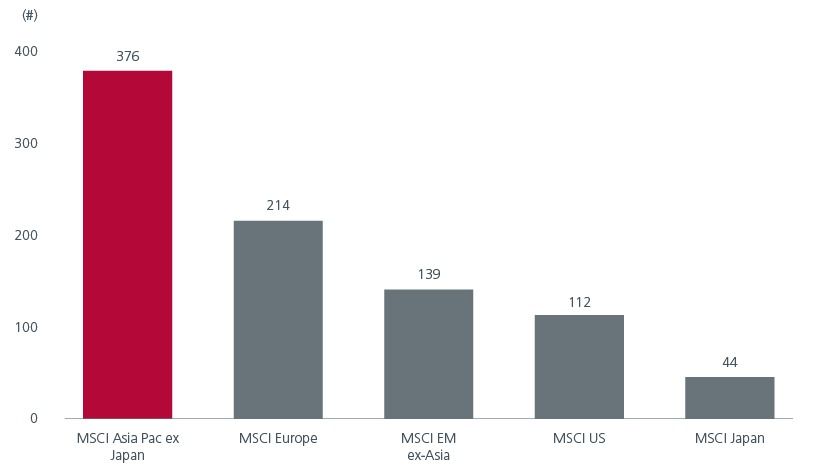
Asian equity income: Asian dividend equities offer one of the most compelling income opportunities globally. Compared to the rest of the world, Asia Pacific ex Japan has the highest number of companies (376) with dividend yields above 3%, reflecting a strong focus on shareholder returns. See Fig. 1. A higher composition of technology stocks in Asia’s high dividend yielding index suggests that an Asian equity income strategy can deliver both income and growth. An active approach can identify emerging income opportunities that may be missed by passive or screen‑based strategies, deliver incremental income through innovative strategies and identify risks to dividend sustainability.
Fig. 1. Asia has more companies with dividend yields above 3%
Source: Eastspring Investments, MSCI, as at 31 December 2025. The use of indices as proxies for the past performance of any asset class/sector is limited and should not be construed as being indicative of the future.
Low volatility equities: A low volatility strategy offers investors a more defensive way to access Asian equities. By systematically focusing on stocks with more stable price behaviour, low volatility strategies aim to reduce drawdowns and smooth returns over time - an attribute that is particularly valuable during periods of heightened uncertainty. In addition, by tilting towards more stable, cash‑generative companies, low volatility strategies can also deliver income, potentially providing attractive total returns for investors.
Singapore: The Singapore equity market offers a mix of blue-chip large caps – companies with stable business models which are relatively defensive, and a growing small and mid-cap universe that offers exposure to emerging growth sectors. As such, a strategy that allocates to both segments can potentially deliver yield and capital growth. The ongoing market reforms from the Equity Market Development Programme should help underpin the market. A revival in Initial Public Offering (IPO) activity should broaden the investable universe, deepen market liquidity, and reinforce investor interest.
Asian bonds: Asian bonds have shown greater resilience even as persistent deficits and rising government debt levels lift volatility in developed market (DM) bonds. Not only are Asian bonds more resilient, but they have also historically delivered competitive long-term total returns. This means that adding Asian bonds to a portfolio of US/global bonds can improve the risk-return balance. Active management is key to navigating the region’s varying credit fundamentals, policy paths, and local market dynamics. Flexible bond strategies that can access both the USD and local currency Asian bond markets, while managing currencies dynamically, are best placed to capture the opportunities within Asian bonds and deliver total returns.
Capital growth
Asia: A broad Asian exposure taps into the region’s structural growth drivers, while a value approach adds resilience through its focus on fundamentals and inherent quality bias. This should be beneficial especially during uncertain or volatile markets. Factor returns over the last 3 and 10 years show that the value and yield factors have performed well in Asia, while the growth factor scores better in the US1. Given its differentiated outcome, a value strategy can provide diversification to US and Asian growth strategies in portfolios.
While a broader Asian strategy can be a core allocation in portfolios, single county strategies may appeal to investors who are looking for undiluted exposure and want to take advantage of a specific macro or earnings cycle.
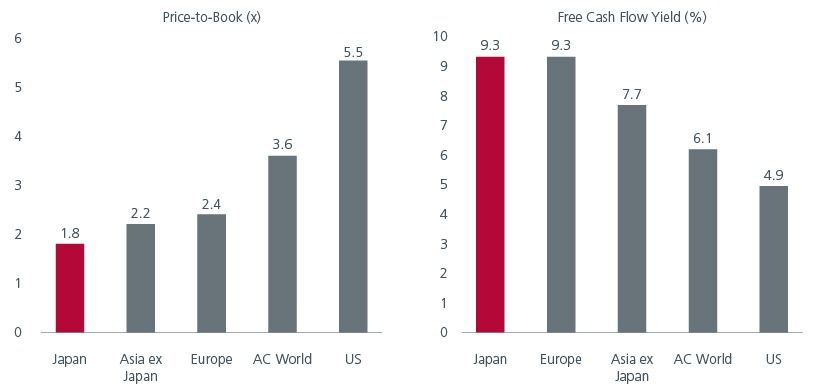
Japan: Prime Minister Takaichi’s landslide victory in February brings about greater policy certainty and a pro-growth agenda. Besides greater government support for the ship building and semiconductor industries, the recovery in global capital spending is expected to underpin earnings in the machinery and automation industries. A potential rise in real wage growth later this year should further support domestic-linked sectors. At the same time, ongoing improvements in corporate governance and capital discipline are likely to continue to lift the market’s return on equity. After the Japanese market’s strong rally in 2025, a value strategy can help investors avoid crowded trades and over-valued stocks while an inherent quality bias can help stabilise portfolios during volatile times. Fig. 2.
Fig. 2. Japan: Valuations are attractive versus other developed markets
Source: Eastspring Investments (Singapore), MSCI Indices, Refinitiv Datastream, as at 31 December 2025. The use of indices as proxies for the past performance of any asset class/sector is limited and should not be construed as being indicative of the future.
India: After underperforming in 2025, the Indian market’s current valuations offer investors a compelling entry point. Macro fundamentals are much improved - Compared to 10 years ago, inflation is at its lowest, foreign exchange reserves have more than doubled, the current account deficit is under control, and fiscal discipline has strengthened. While elevated energy prices, if sustained, could disrupt India’s near-term growth path, favourable demographics, rising incomes, urbanisation, and policy reforms are expected to continue to keep India’s long-term trend growth intact. Notably, India’s frequent policy actions, regulatory decisions and corporate actions create event driven opportunities which can potentially provide greater alpha for long-term investors.
Interesting reads








Sources:
1 Bloomberg factor returns. As of 28 January 2026.
Singapore by Eastspring Investments (Singapore) Limited (UEN: 199407631H)
Australia (for wholesale clients only) by Eastspring Investments (Singapore) Limited (UEN: 199407631H), which is incorporated in Singapore, is exempt from the requirement to hold an Australian financial services licence and is licensed and regulated by the Monetary Authority of Singapore under Singapore laws which differ from Australian laws
Hong Kong by Eastspring Investments (Hong Kong) Limited and has not been reviewed by the Securities and Futures Commission of Hong Kong.
Indonesia by PT Eastspring Investments Indonesia, an investment manager that is licensed, registered and supervised by the Indonesia Financial Services Authority (OJK).
Malaysia by Eastspring Investments Berhad (200001028634/ 531241-U) and Eastspring Al-Wara’ Investments Berhad (200901017585 / 860682-K).
Thailand by Eastspring Asset Management (Thailand) Co., Ltd.
United States of America (for institutional clients only) by Eastspring Investments (Singapore) Limited (UEN: 199407631H), which is incorporated in Singapore and is registered with the U.S Securities and Exchange Commission as a registered investment adviser.
European Economic Area (for professional clients only) and Switzerland (for qualified investors only) by Eastspring Investments (Luxembourg) S.A., 26, Boulevard Royal, 2449 Luxembourg, Grand-Duchy of Luxembourg, registered with the Registre de Commerce et des Sociétés (Luxembourg), Register No B 173737.
Chile (for institutional clients only) by Eastspring Investments (Singapore) Limited (UEN: 199407631H), which is incorporated in Singapore and is licensed and regulated by the Monetary Authority of Singapore under Singapore laws which differ from Chilean laws.
The afore-mentioned entities are hereinafter collectively referred to as Eastspring Investments.
The views and opinions contained herein are those of the author, and may not necessarily represent views expressed or reflected in other Eastspring Investments’ communications. This document is solely for information purposes and does not have any regard to the specific investment objective, financial situation and/or particular needs of any specific persons who may receive this document. This document is not intended as an offer, a solicitation of offer or a recommendation, to deal in shares of securities or any financial instruments. It may not be published, circulated, reproduced or distributed without the prior written consent of Eastspring Investments. Reliance upon information in this document is at the sole discretion of the reader. Please carefully study the related information and/or consult your own professional adviser before investing.
Investment involves risks. Past performance of and the predictions, projections, or forecasts on the economy, securities markets or the economic trends of the markets are not necessarily indicative of the future or likely performance of Eastspring Investments or any of the funds managed by Eastspring Investments.
Information herein is believed to be reliable at time of publication. Data from third party sources may have been used in the preparation of this material and Eastspring Investments has not independently verified, validated or audited such data. Where lawfully permitted, Eastspring Investments does not warrant its completeness or accuracy and is not responsible for error of facts or opinion nor shall be liable for damages arising out of any person’s reliance upon this information. Any opinion or estimate contained in this document may subject to change without notice.
Eastspring Investments companies (excluding joint venture companies) are ultimately wholly owned/indirect subsidiaries of Prudential plc of the United Kingdom. Eastspring Investments companies (including joint venture companies) and Prudential plc are not affiliated in any manner with Prudential Financial, Inc., a company whose principal place of business is in the United States of America or with the Prudential Assurance Company Limited, a subsidiary of M&G plc (a company incorporated in the United Kingdom).