





June 2024 | 5 min read


Executive Summary
- Vietnam equities delivered annualised returns of 8.5% p.a. (in USD terms) over the last five years. Additionally, their low correlations with the developed markets help them to provide investors with enhanced portfolio diversification.
- The Vietnam equity market allows investors to participate in a dynamic economy with opportunities that tap into the country’s manufacturing competitiveness, digital transformation and growing middle class.
- Vietnam’s bid for emerging market status can potentially result in greater investor interest and inflows. However, addressing the challenges related to settlement procedures and foreign ownership caps remains crucial.
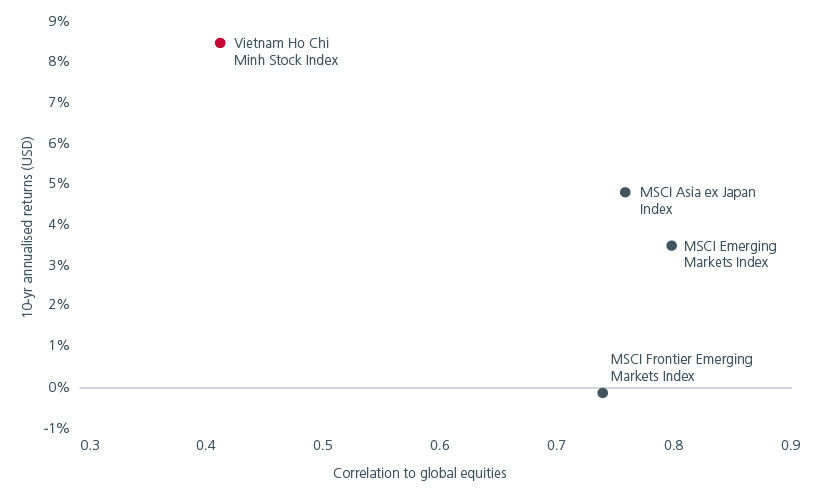
Over the last five years1, the Vietnam Ho Chi Minh Stock Index (VNINDEX) delivered annualised returns of 8.5% p.a. (in USD terms), outperforming both the MSCI Frontier Emerging Markets and MSCI Emerging Markets Indexes. More importantly, Vietnam equities exhibit lower correlations than MSCI Emerging Markets to developed markets, potentially providing investors with enhanced portfolio diversification, although with greater volatility. See Fig. 1.
Fig. 1. Correlations vs annualised returns
Source: Bloomberg. Annualised returns in USD terms as of 10 May 2024. 10-year correlations using weekly data in local currency terms, as of 13 May 2024.
Exciting opportunities
Vietnam’s robust economic growth is expected to help underpin the equity market going forward. The IMF forecasts Vietnam’s economic growth to expand 5.8% in 2024 and 6.5% in 2025, up from 5% in 20232.
Supply chain shifts
Global supply chain shifts have boosted Vietnam’s growth, with the country often referred to as the “China plus one” destination. Vietnam benefits from its cost-effective manufacturing capabilities and skilled labour force. Its proximity to China also facilitates streamlined logistics and efficient coordination between suppliers and manufacturers. At the same time, Vietnam’s status as a net energy exporter and its increasing efforts to diversify its energy sources to include renewable energy enhance its energy security and sustainability.
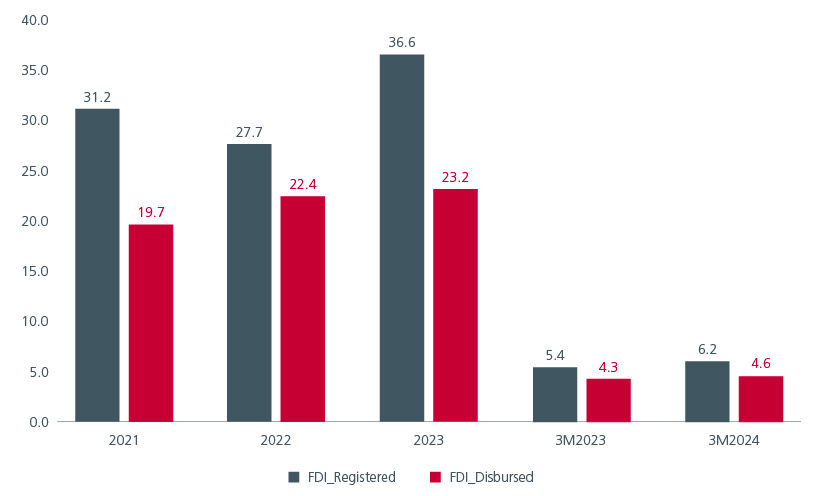
Vietnam attracted USD36.6 billion in foreign direct investment (FDI) in 2023, of which USD23 billion was disbursed, representing the highest level of FDI in Vietnam in the recent five years. The processing manufacturing sector received 64% of the total FDI capital. For 2024, total newly-registered FDI reached USD6.2 billion, representing a 13.4% year-on-year increase. Fig. 2. As the government continues to actively promote FDI through favourable policies including tax incentives, exemptions and streamlined administrative procedures, these investments should boost jobs, infrastructure development and overall economic growth.
Fig. 2. FDI into Vietnam (USD billion)
Source: General Statistics Office of Vietnam, as of 31 March 2024.
Growing FDI inflows are expected to drive industrial park (IP) demand, which should support rents. We like developers that can create a complete IP ecosystem by linking IPs with residential homes, utilities and social infrastructure as well as those that have large leasable areas to meet the needs of global manufacturers.
Digital transformation
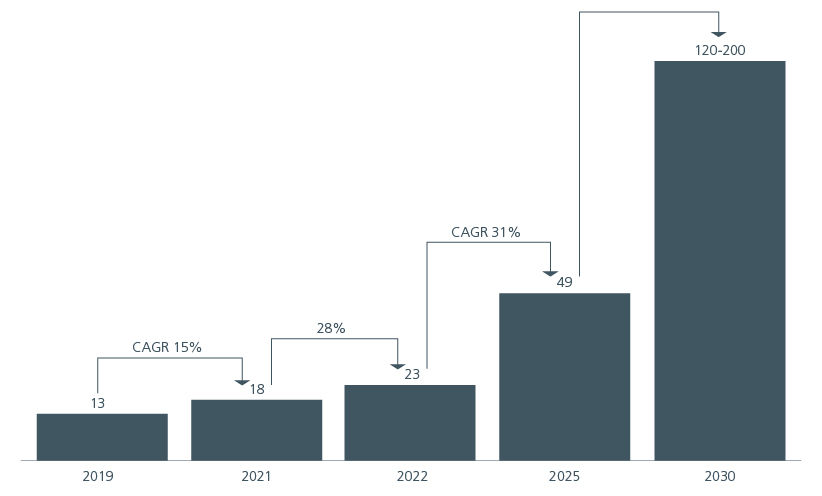
We also see opportunities in technology companies that can leverage on the government’s ambition to accelerate digital transformation within the country as laid out in the Digital Transformation Agenda. Domestic spending on digital infrastructure is expected to be significant amid rising digitalisation across industries, following years of underinvestment. The gross merchandise value of Vietnam’s digital economy in 2022 was USD23 billion, and is forecasted reach USD49 billion in 2025, largely driven by the e-commerce sector.
Fig. 3. Gross merchandise value of Vietnam’s digital economy (USD billion)
Source: Vietnam’s digital economy value and compositions. Bain Report 2022.
Rising middle income
The couThe country’s robust economic growth has also created a rapidly expandingntry’s robust economic growth has also created a rapidly expanding middle income population. Investing in Vietnam’s equity market potentially provides exposure to sectors such as retail, real estate, and consumer goods that stand to benefit from rising disposable incomes. Vietnam’s banks are increasingly focusing on the still-underdeveloped retail banking segment to diversify their income streams and improve profit margins. Digitalisation is also helping to reduce operational costs and supporting earnings growth. Compared to their ASEAN peers, Vietnamese banks generate higher return on equity (ROE).
Emerging market bid
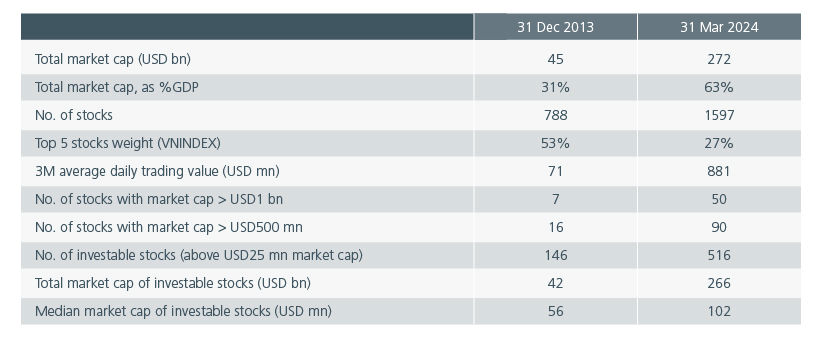
Vietnam is committed to strengthen its capital market to drive economic growth and stability. The equity market has grown rapidly over the last decade in breadth and depth (Fig. 4.) With the equity market’s current capitalisation averaging 60% of GDP, the government aims to raise market capitalisation further to 100% and 120% of GDP by 2025 and 2030, respectively. The government’s crackdown on corruption also demonstrates its commitment to maintain a more transparent and investor-friendly environment.
Fig. 4. Vietnam’s equity market has grown rapidly
Source: Bloomberg data as of 31 March 2024, computed by EIVN. Note: VNINDEX = Vietnam Ho Chi Minh Stock Index.
Vietnam has been working towards achieving an emerging market status by July 2025 which can potentially result in greater investor interest and inflows. However, addressing the challenges related to settlement procedures and foreign ownership caps remains crucial. On this front, Vietnam is piloting a trading system to resolve the need to have available funds before an order can be made, as well as to shorten the settlement cycle, although the system has yet to be officially launched.
Promising potential
The Vietnam equity market allows investors to participate in a dynamic economy with promising potential. The market’s return on equity had averaged 14.6% over the last five years, surpassing its ASEAN peers, and is forecasted to remain relatively steady at 14% in 20253. Whether it is tapping into Vietnam’s manufacturing advantages, leveraging on the country’s digital transformation, or capitalising on its growing middle class, Vietnam presents an exciting opportunity for long-term investors.
Interesting reads