





Mar 2025 | 5 min read


Executive Summary
My recent back-to-back trips to China and India reinforced several of our investment convictions and offered new insights into these markets’ investment landscape. Here are my key takeaways:
- A palpable sense of improvement in China’s old economy sectors
- Chinese government directives are driving some changes
- Indian government has prioritised fiscal discipline for now
- India’s structural growth story remains very much intact

China: Live-streaming of product promotions within a MNC sportswear store in Beijing; we also noticed limited discounting across domestic and MNC brands we visited – a good indicator of industry inventory level.

India: Showflat at a new township project in Dharavi, Mumbai. This is the first-of-its-kind township development in the suburb of Dharavi – a good example of how some developers are able to create new demand amidst the property upcycle.
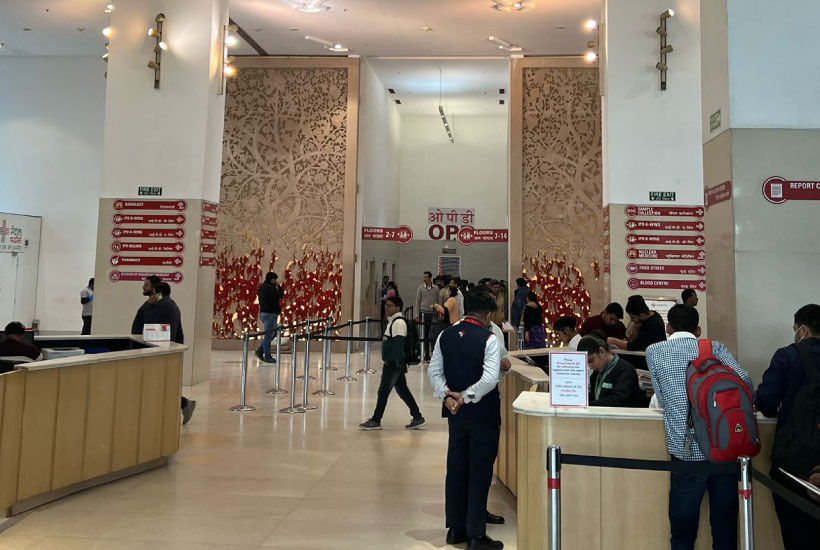
India: A dedicated counter is set up for Ayushman Bharat (govt scheme) patients (RHS photo), who provide a base load to anchor occupancy. Longer term, rising insurance penetration continues to be the key driver for the industry.
China
Old economy set to rebound
In China, I visited machinery companies across eight cities in both Tier 1 and Tier 2 cities. Having taken the same trip last year, I noticed that fundamentals and sentiment have visibly improved. There was a sense of optimism amongst machinery dealers and almost all companies indicated similar positive momentum in project starts post Chinese New Year. This is in stark contrast to last year’s sluggishness.
Part of this optimism stems from local governments, energised by new funding from special local bond issuance, prioritising new starts over completion to boost local GDP growth. The first quarter guidance is looking strong for some sub sectors such as excavators and heavy-duty trucks (HDT). In particular, the penetration of electric HDT is rising rapidly given falling battery prices and improving economics.
There is upside risk to the conservative full-year guidance if the current momentum sustains. The street typically underestimates the extent of earnings recovery in a cyclical upturn; the key is to identify early datapoints such as the March sales data, the peak season, to assess the strength of the upturn.
Directives steering changes
Every company I met talked about reduced domestic pricing pressure this year likely due to a top-down directive to curb internal competition. In line with this, there seems to be limited discounting tactics from both domestic and multinational consumer brands.
Similarly, there seems to be a top-down initiative by regulators on both sides encouraging companies to pursue dual A and H share listings, even if they do not need additional cash. One plausible reason could be to ensure companies have the support of their A-share stock performance ahead of H-share listing. Given this, and assuming that market sentiment stays buoyant, more dual A and H-share listings are expected in the second half of this year. China brokers will be the key beneficiaries, having had a low earnings base in the last two years.
India
Government has clear priorities
From my meetings with the relevant ministries and the central bank, it is clear the Indian government is not losing sleep over the country’s near-term growth slowdown, preferring to monitor the impact of the tax cuts on domestic consumption and US trade policies on growth.
Fiscal discipline remains a key priority while monetary policy will remain neutral. Contrary to market talk, capex has not been de-prioritised; it remains at 3% of GDP and focused on urban infrastructure and agriculture, and fostering state competition. That said, it is consumption that is taking the limelight as investors anticipate positive impact from the tax cuts that could be more evident in 2HFY26.
Key sector takeaways
Property (positive): On-the-ground checks suggest property demand remains robust. A sales representative of an ultra-luxury project in Gurgoan confirms that they had to turn away demand ahead of their official launch. To be sure, property stocks are high beta and could underperform in the near term. Still there are stocks that are attractively valued and backed by cash flows and landbank.
Hospitals (positive): I spent an afternoon visiting a 1000-bed private hospital in Gurgoan, one of India’s finance and technology business hubs, and was very impressed by the space, ambience and facilities. Meetings with various companies also suggest that regulatory pricing caps are a non-issue, with rising private health insurance penetration addressing pricing inflation. The outlook for this segment remains positive despite the incoming competition.
Quick commerce (positive): All indications point towards a fast-growing sector despite heightened competition; the segment currently comprises 2% of overall retail sector with a potential to grow up to 10%. The companies I spoke to revealed that more premium products are being sold and that buyers are paying for convenience instead of shopping for discounts. This growing pie should be able to accommodate the three big competitors.
Microfinance (negative): The Karnataka ordinance to crack down on unregulated lending activities will likely delay the recovery of this sector by another quarter or two. Most importantly, there is a pending bill that essentially takes this regulation nationwide and could create a lot of near-term disruptions in the low-end unsecured space (similar to demonetization).
A final point to note is that the Indian equity market continues to be supported by domestic flows and investors are increasing their subscription ticket size in a down-market. There is still a lot of cash on the sidelines, waiting for the right time to buy. Valuations are getting attractive, while the structural growth story remains very much intact.
Interesting reads