




May 2026|5 min read


Executive Summary
- AI is becoming a structural growth driver for Asia, anchored by data centre build outs and leadership in tech hardware supply.
- The next phase of AI investing in Asia is less about headline growth and more about the durability of cash flows and returns generated by AI spending.
- AI investing does not favour any one investment style; success hinges on identifying companies that can monetise AI.
Artificial Intelligence (AI) is becoming an increasingly important structural force for Asia. The region’s export strength is now being supported by AI‑related demand, particularly across AI infrastructure, semiconductors, and technology supply chains. Equally, the scale of investment, especially in data centres and supporting infrastructure is significant. Asia is both a key supplier of tech hardware and the second-fastest growing region for data centre capacity.
Fig 1: China dominates Asian data centre growth
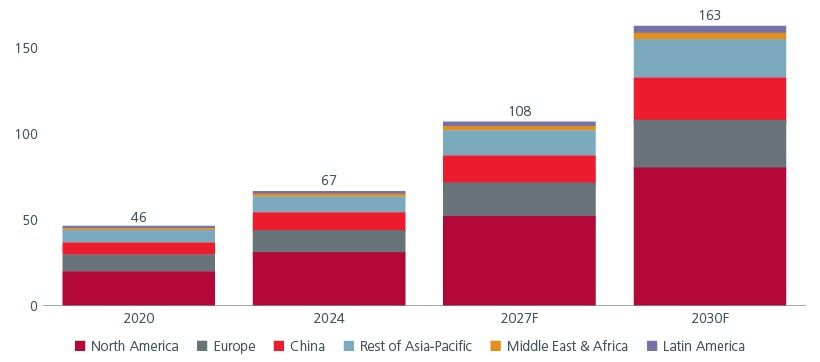
Source: Bain Data Centre Model, 2025. Notes: Assumes baseline scenario of sector growth; values are rounded
However, the key constraint on AI data centre expansion across Asia is power delivery. The ability to scale efficiently is increasingly shaped by power availability, grid reliability, energy mix, and policy execution. These factors are emerging as key differentiators across Asian markets.
Fig 2: AI data centre potential electricity readiness capacity
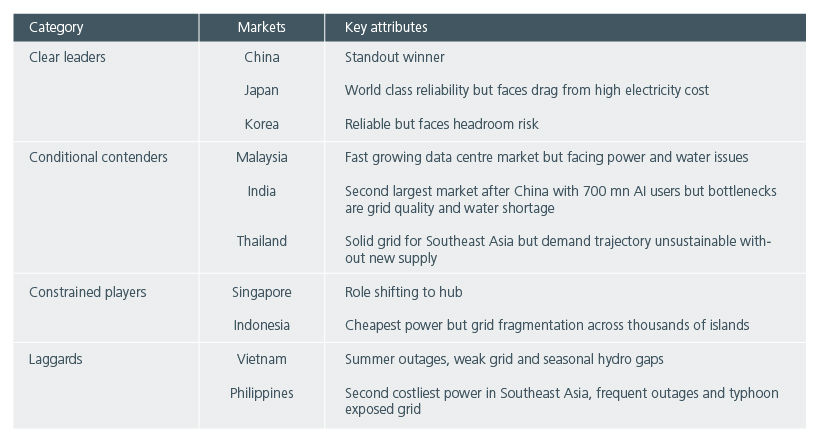
Source: IEA Energy & AI 2025; Wood Mackenzie; Deloitte APAC 2026; Ember; IEEFA; Introl/BofA; PwC APAC Clean Energy Gap; SemiAnalysis
Against this backdrop, AI exposure in Asia needs to be selective. Companies supplying the AI investment cycle stand out as the capex boom appears likely to persist despite higher energy prices. Nonetheless the proof lies in earnings delivery as the focus shifts to the durability of cash flows and returns generated by AI spending.
The Q & A with Sundeep Bihani (Portfolio Manager, Regional Asia Value Equities), John Tsai (Head of Growth Equities) and Christina Woon (Head of Equity Income) outlines how they are approaching AI opportunities across Asia.
Q1. Is the AI opportunity in pure plays or adopters?
Sundeep: It is not a simple choice between pure plays and adopters. Focus on durable businesses where AI improves value and lowers costs, avoid value traps, and look to sectors such as industrials, financials, and travel where AI is lifting efficiency without the hype.
John: From a growth perspective, the most compelling AI opportunities are where the pace and scale of growth remain underestimated. In several cases, particularly in Korea and Taiwan, growth assumptions have had to be revised upwards as demand has outpaced expectations.
Christina: For income investors, AI matters only where it supports rising revenues, resilient cash flows, and long‑term income stability. Look for companies funding AI investment from internal cash flows which helps to preserve balance sheet strength and underpin sustainable income generation.
Q2. How can investors spot AI hype versus real earnings impact?
Sundeep: A clear red flag is crowded trades where markets already price in years of supernormal returns. Be wary of theme‑chasing and focus on businesses with a proven ability to navigate past cycles and adopt new technology in a disciplined way.
Christina: AI hype is evident when companies talk about rising AI capex without a clear monetisation plan or visibility on how it will drive revenues, efficiency, and cash flows.
John: Some companies are engaging in AI‑driven capex races out of fear of falling behind competitors, reinforcing the need to look past the narrative and focus on the numbers.
Q3. Which business models are most at risk of value erosion due to AI?
Sundeep: Businesses that rely on large, fixed investments but face rapid AI‑driven substitution are particularly vulnerable. This is why an active approach is needed to pick the winners.
John: AI has the potential to accelerate competitive shifts, with rapid breakthroughs resetting winners far faster than in previous technology cycles and eroding established advantages sooner than investors expect.
Q4. Have you incorporated AI tools in your investment process?
Christina: AI is primarily used to improve research productivity by speeding up the information processing and surfacing key risks earlier. AI acts as a tool to improve efficiency, not to replace judgement and decision-making.
Sundeep: The team uses AI primarily as a risk management tool rather than for stock selection, stress‑testing whether a business can be made obsolete in the next three to five years. These insights are then reflected in valuation work and assumptions around normalised earnings.
John: With traditional sell‑side research becoming less differentiated, AI can improve internal analysis efficiency and enable greater experimentation.
Q5. What are the key implications for investors?
For growth investors, the challenge lies in distinguishing companies already monetising AI from those investing with uncertain payback. Rising AI budgets and rapid infrastructure deployment support a selective approach, although faster earnings growth, particularly in the US, has made valuations harder to anchor.
From a value perspective, AI can reshape the earnings trajectory for low‑growth or cyclical businesses by improving efficiency, costs, and customer value. With AI expectations in Asia still relatively conservative, valuation discipline, margin of safety and normalised returns remain central.
One of the biggest misconceptions for income investors is that AI is less relevant as a theme because it is capex heavy. However, many companies in Asia, especially those that play into the AI capex boom, are beneficiaries of AI via rising revenues and cash flows, and consequently dividends. The key is to identify the right ones through active stock picking.
Interesting reads








Singapore by Eastspring Investments (Singapore) Limited (UEN: 199407631H)
Australia (for wholesale clients only) by Eastspring Investments (Singapore) Limited (UEN: 199407631H), which is incorporated in Singapore, is exempt from the requirement to hold an Australian financial services licence and is licensed and regulated by the Monetary Authority of Singapore under Singapore laws which differ from Australian laws
Hong Kong by Eastspring Investments (Hong Kong) Limited and has not been reviewed by the Securities and Futures Commission of Hong Kong.
Indonesia by PT Eastspring Investments Indonesia, an investment manager that is licensed, registered and supervised by the Indonesia Financial Services Authority (OJK).
Malaysia by Eastspring Investments Berhad (200001028634/ 531241-U) and Eastspring Al-Wara’ Investments Berhad (200901017585 / 860682-K) and has not been reviewed by Securities Commission of Malaysia.
Thailand by Eastspring Asset Management (Thailand) Co., Ltd.
United States of America (for institutional clients only) by Eastspring Investments (Singapore) Limited (UEN: 199407631H), which is incorporated in Singapore and is registered with the U.S Securities and Exchange Commission as a registered investment adviser.
European Economic Area (for professional clients only) and Switzerland (for qualified investors only) by Eastspring Investments (Luxembourg) S.A., 26, Boulevard Royal, 2449 Luxembourg, Grand-Duchy of Luxembourg, registered with the Registre de Commerce et des Sociétés (Luxembourg), Register No B 173737.
Chile (for institutional clients only) by Eastspring Investments (Singapore) Limited (UEN: 199407631H), which is incorporated in Singapore and is licensed and regulated by the Monetary Authority of Singapore under Singapore laws which differ from Chilean laws.
The afore-mentioned entities are hereinafter collectively referred to as Eastspring Investments.
The views and opinions contained herein are those of the author, and may not necessarily represent views expressed or reflected in other Eastspring Investments’ communications. This document is solely for information purposes and does not have any regard to the specific investment objective, financial situation and/or particular needs of any specific persons who may receive this document. This document is not intended as an offer, a solicitation of offer or a recommendation, to deal in shares of securities or any financial instruments. It may not be published, circulated, reproduced or distributed without the prior written consent of Eastspring Investments. Reliance upon information in this document is at the sole discretion of the reader. Please carefully study the related information and/or consult your own professional adviser before investing.
Investment involves risks. Past performance of and the predictions, projections, or forecasts on the economy, securities markets or the economic trends of the markets are not necessarily indicative of the future or likely performance of Eastspring Investments or any of the funds managed by Eastspring Investments.
Information herein is believed to be reliable at time of publication. Data from third party sources may have been used in the preparation of this material and Eastspring Investments has not independently verified, validated or audited such data. Where lawfully permitted, Eastspring Investments does not warrant its completeness or accuracy and is not responsible for error of facts or opinion nor shall be liable for damages arising out of any person’s reliance upon this information. Any opinion or estimate contained in this document may subject to change without notice.
Eastspring Investments companies (excluding joint venture companies) are ultimately wholly owned/indirect subsidiaries of Prudential plc of the United Kingdom. Eastspring Investments companies (including joint venture companies) and Prudential plc are not affiliated in any manner with Prudential Financial, Inc., a company whose principal place of business is in the United States of America or with the Prudential Assurance Company Limited, a subsidiary of M&G plc (a company incorporated in the United Kingdom).