







Hi, how can I assist?
Give me a summary of the article
Each technology cycle creates new leaders and investment opportunities, with the current cycle defined by Artificial Intelligence (AI), a technology that is widely seen as transformative.
The AI cycle is likely to unfold in phases, creating broad investing opportunities, especially in companies that can scale, execute and monetise AI as the cycle matures.
Investors should look beyond US AI leaders to capture value in Asian supply chain players, which are critical to enabling and scaling the AI ecosystem.
Since the 1960s, major technological developments have reshaped how people live, work, and connect. Each new wave of technology has created clear leaders and generated attractive investment returns. However, some of these periods have been marked by boom‑bust cycles, underscoring the need to distinguish hype from reality.
The latest wave is Artificial Intelligence (AI), a technology that is widely seen as transformative. Earlier technology cycles largely improved access, efficiency and connectivity but AI goes further by reshaping how work is done and how decisions are made across industries.
AI stands out in two ways. First, where previous technologies changed how people accessed, communicated, and consumed, AI changes how they think, decide, and create. Second, it can be applied across industries, giving it a broader opportunity set, while its foundation on existing digital infrastructure lowers barriers to deployment and accelerates adoption.
As AI adoption is both faster and broader than in previous cycles, the speed can compress market cycles, leading to sharper swings in expectations and valuations. This makes it even more important for investors to distinguish winners from laggards.
What are some key insights from previous tech cycles?
Every technology cycle goes through periods when expectations run ahead of reality. Whether today’s AI leaders will remain tomorrow’s market leaders is difficult to predict. Looking back at earlier cycles can therefore offer useful perspectives on how value was created, where it was concentrated, and what investors should look out for in the current cycle.
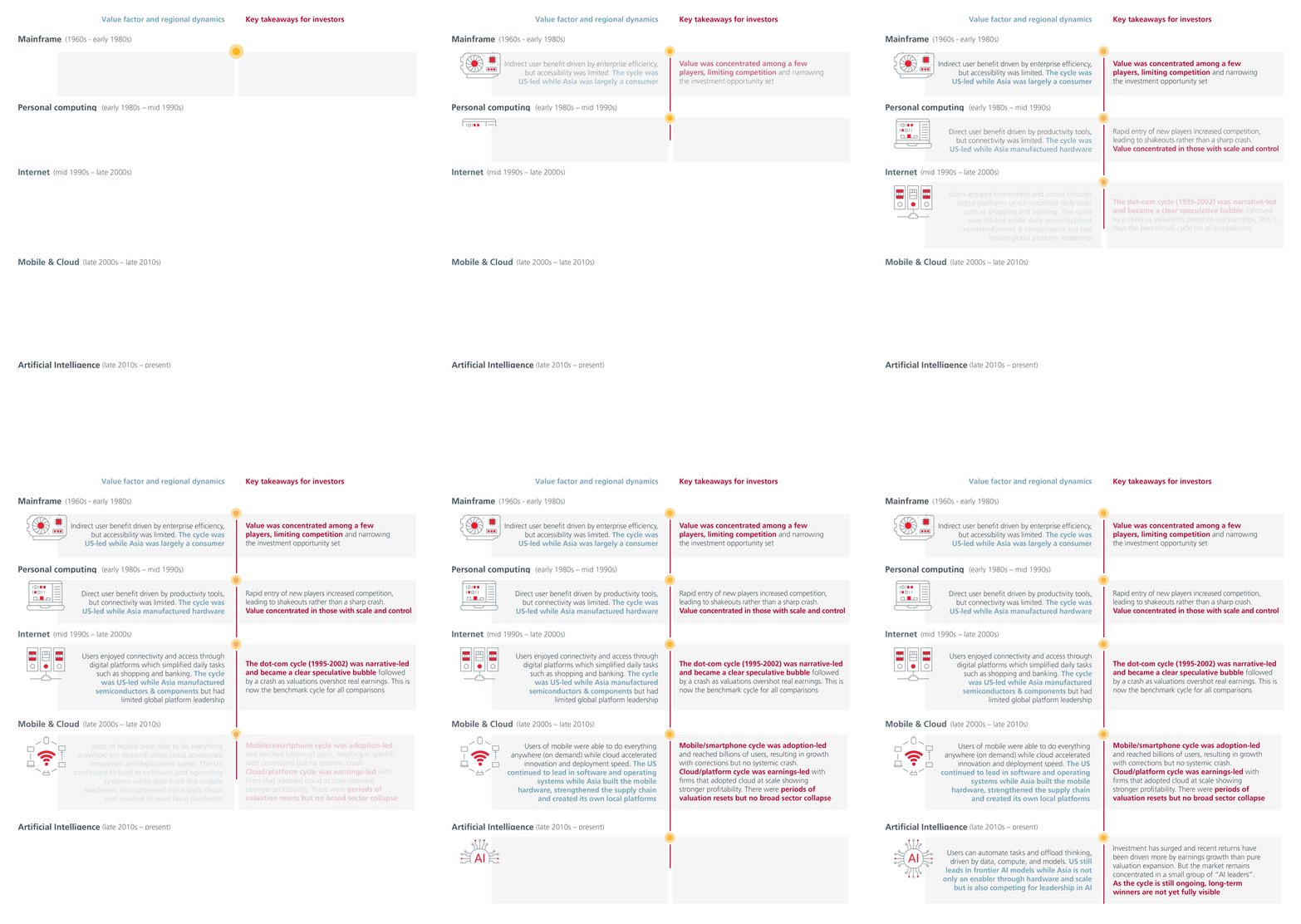
Fig 1: Major tech cycles since the 1960s
Source: Eastspring Investments. June 2026
From Fig 1, it is evident that Asia’s role in technology has changed meaningfully across the cycles. Equally it is important to note that strong technology does not always translate into strong investment outcomes. Leadership changes over time, value often becomes concentrated, and periods of excessive optimism can create concentration and valuation risks. This makes disciplined stock selection critical.
Which stage of the AI cycle are we in today?
A typical tech cycle moves from an early phase of rapid growth and hype, into the mid stage of monetisation and earnings before maturing in the late part of the cycle which is a period of consolidation and slower growth. Importantly, technology cycles do not disappear, they evolve, build on existing infrastructure and ecosystems, and become the foundation for the next wave.
The internet enabled connectivity and platforms, mobile extended this through devices and ecosystems, and cloud remains the backbone for AI. While these earlier waves have moved beyond their peak growth phase, they remain structurally important and continue to generate stable, durable earnings and cashflow.
AI remains in a build-out stage with investment concentrated in infrastructure such as compute capacity and data centres. Comparison with the dot-com cycle is understandable because both cycles have been marked by strong optimism, heavy capital inflows and expectations being priced in early. But this tech cycle seems different for three reasons:
- AI disruption is real and monetisation is increasingly visible but remains uneven, with earnings still driven by a relatively narrow group of leaders
- Token demand growth is exponential and outpacing compute capacity. The shift from training to inference widens this gap, as demand becomes continuous and grows
- For hyperscalers, first mover advantage to secure compute capacity is key. With production capacity now the constraint, it is no longer about price, but about who can deliver quickly and at scale.
What should investors focus on now?
The AI cycle is likely to unfold across multiple phases within a longer-term structural trend, creating a broad set of opportunities. However, it is not without risks. Elevated expectations and heavy investment raise the likelihood of periodic pullbacks.
Unlike the dot-com cycle, which was largely valuation-driven with limited earnings support, the current cycle is already seeing tangible earnings contribution, albeit concentrated. That said, outcomes will still be shaped by regulation, competition and geopolitical dynamics across the value chain.
At this stage, the key risk is overpaying at the wrong point in the cycle. The focus should be on identifying companies that are already monetising AI or have clear pricing power, and can scale, execute and compound as the cycle matures.
The opportunity set is also not evenly distributed. Much of the current focus is on a narrow group of US-listed companies, but this captures only part of the ecosystem. The distinction between where AI is developed and where it is enabled is also increasingly important. While the US has played a key role in AI creation, the Asian supply chain manufacturers have formed a backbone to all the developments and progress that AI has made over the past 4 years.
Fig 2: AI spans a multi layered value chain

Source: Eastspring Investments. June 2026
From the evolution of Generative AI through to the current stage of Agentic AI and, in the future to Physical AI, Asian supply chain manufacturers in Taiwan, South Korea, China and Japan will continue to play a pivotal role in enabling the evolution and scaling of the AI ecosystem. Understanding where value is created and how Asia captures it is critical for investors.
This article is the first in a five part series on the AI technology cycle and the investment opportunities in Asia as the cycle evolves and matures. Explore the full series.
Look out for the next article Why invest in Asia Tech which examines how investors can access AI growth through Asia’s supply chain, where value is increasingly being created and captured.
Interesting reads

Singapore by Eastspring Investments (Singapore) Limited (UEN: 199407631H)
Australia (for wholesale clients only) by Eastspring Investments (Singapore) Limited (UEN: 199407631H), which is incorporated in Singapore, is exempt from the requirement to hold an Australian financial services licence and is licensed and regulated by the Monetary Authority of Singapore under Singapore laws which differ from Australian laws
Hong Kong by Eastspring Investments (Hong Kong) Limited and has not been reviewed by the Securities and Futures Commission of Hong Kong.
Indonesia by PT Eastspring Investments Indonesia, an investment manager that is licensed, registered and supervised by the Indonesia Financial Services Authority (OJK).
Malaysia by Eastspring Investments Berhad (200001028634/ 531241-U) and Eastspring Al-Wara’ Investments Berhad (200901017585 / 860682-K) and has not been reviewed by Securities Commission of Malaysia.
Thailand by Eastspring Asset Management (Thailand) Co., Ltd.
United States of America (for institutional clients only) by Eastspring Investments (Singapore) Limited (UEN: 199407631H), which is incorporated in Singapore and is registered with the U.S Securities and Exchange Commission as a registered investment adviser.
European Economic Area (for professional clients only) and Switzerland (for qualified investors only) by Eastspring Investments (Luxembourg) S.A., 26, Boulevard Royal, 2449 Luxembourg, Grand-Duchy of Luxembourg, registered with the Registre de Commerce et des Sociétés (Luxembourg), Register No B 173737.
Chile (for institutional clients only) by Eastspring Investments (Singapore) Limited (UEN: 199407631H), which is incorporated in Singapore and is licensed and regulated by the Monetary Authority of Singapore under Singapore laws which differ from Chilean laws.
The afore-mentioned entities are hereinafter collectively referred to as Eastspring Investments.
The views and opinions contained herein are those of the author, and may not necessarily represent views expressed or reflected in other Eastspring Investments’ communications. This document is solely for information purposes and does not have any regard to the specific investment objective, financial situation and/or particular needs of any specific persons who may receive this document. This document is not intended as an offer, a solicitation of offer or a recommendation, to deal in shares of securities or any financial instruments. It may not be published, circulated, reproduced or distributed without the prior written consent of Eastspring Investments. Reliance upon information in this document is at the sole discretion of the reader. Please carefully study the related information and/or consult your own professional adviser before investing.
Investment involves risks. Past performance of and the predictions, projections, or forecasts on the economy, securities markets or the economic trends of the markets are not necessarily indicative of the future or likely performance of Eastspring Investments or any of the funds managed by Eastspring Investments.
Information herein is believed to be reliable at time of publication. Data from third party sources may have been used in the preparation of this material and Eastspring Investments has not independently verified, validated or audited such data. Where lawfully permitted, Eastspring Investments does not warrant its completeness or accuracy and is not responsible for error of facts or opinion nor shall be liable for damages arising out of any person’s reliance upon this information. Any opinion or estimate contained in this document may subject to change without notice.
Eastspring Investments companies (excluding joint venture companies) are ultimately wholly owned/indirect subsidiaries of Prudential plc of the United Kingdom. Eastspring Investments companies (including joint venture companies) and Prudential plc are not affiliated in any manner with Prudential Financial, Inc., a company whose principal place of business is in the United States of America or with the Prudential Assurance Company Limited, a subsidiary of M&G plc (a company incorporated in the United Kingdom).