








Hi, how can I assist?
Give me a summary of the article
Asia tech has outperformed US tech from the point when the generative AI narrative started gaining momentum.
Asia tech companies are AI enablers - supplying semiconductor chips, hardware and infrastructure that make AI deployment possible.
With the US’ dominance (~76%) in global technology benchmarks, investors risk overlooking attractive opportunities and emerging innovators which a dedicated Asia tech allocation can offer.
Although AI-linked US technology companies have captured much of the market spotlight in recent years, the biggest winners from AI may be from Asia. Since 1 October 2022 – the point when the generative AI narrative started gaining momentum – Asia tech stocks have risen 423%, beating US and global tech stocks by 228% and 221% respectively1.
Despite this outperformance, Asian tech stocks remain more attractively valued than their US peers and have stronger forecasted earnings growth. Fig. 1 and 2.
Fig 1. Asia Tech has more attractive valuations
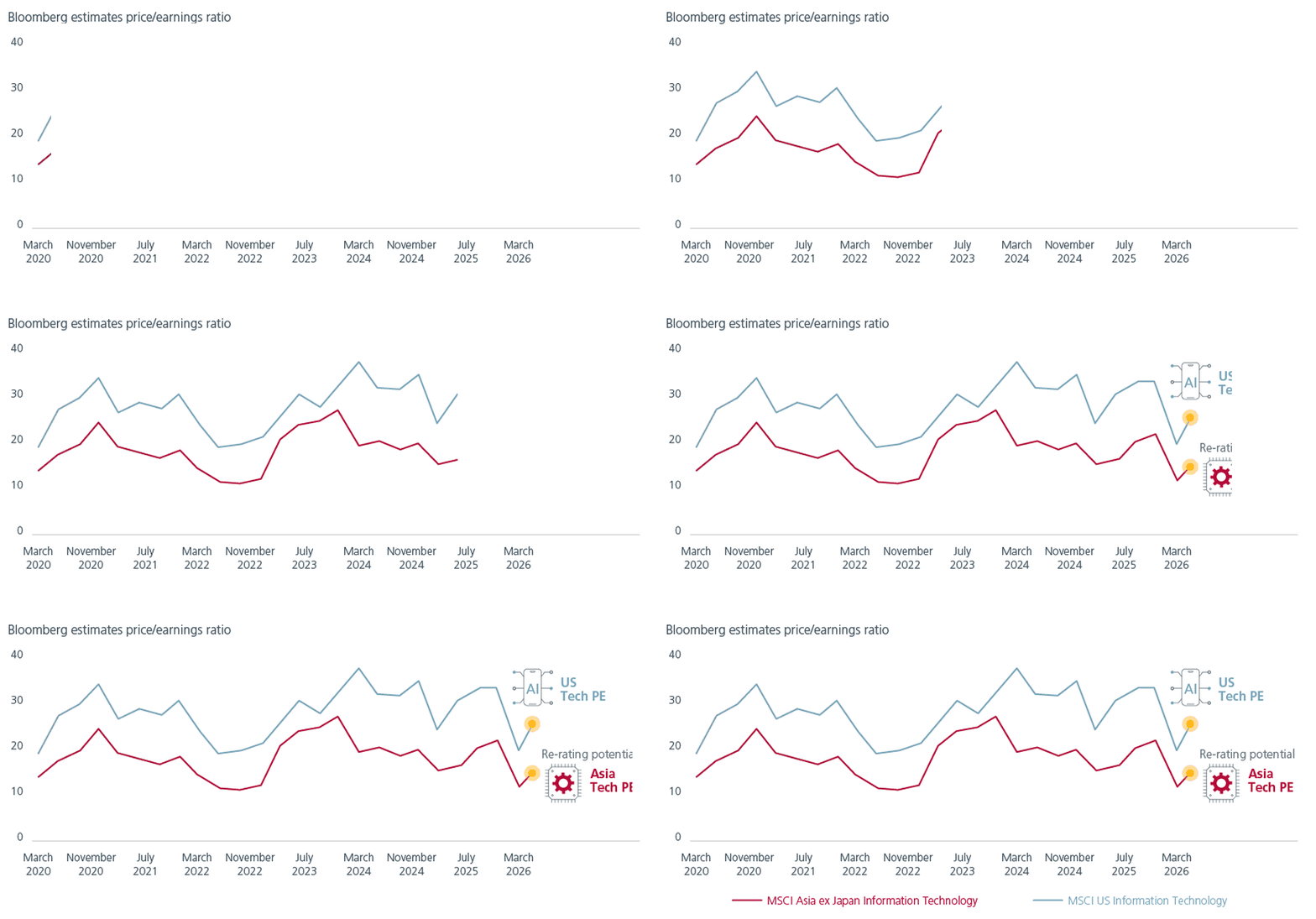
Source: Bloomberg. As of 29 May 2026.
Fig 2. Asia Tech has stronger earnings growth
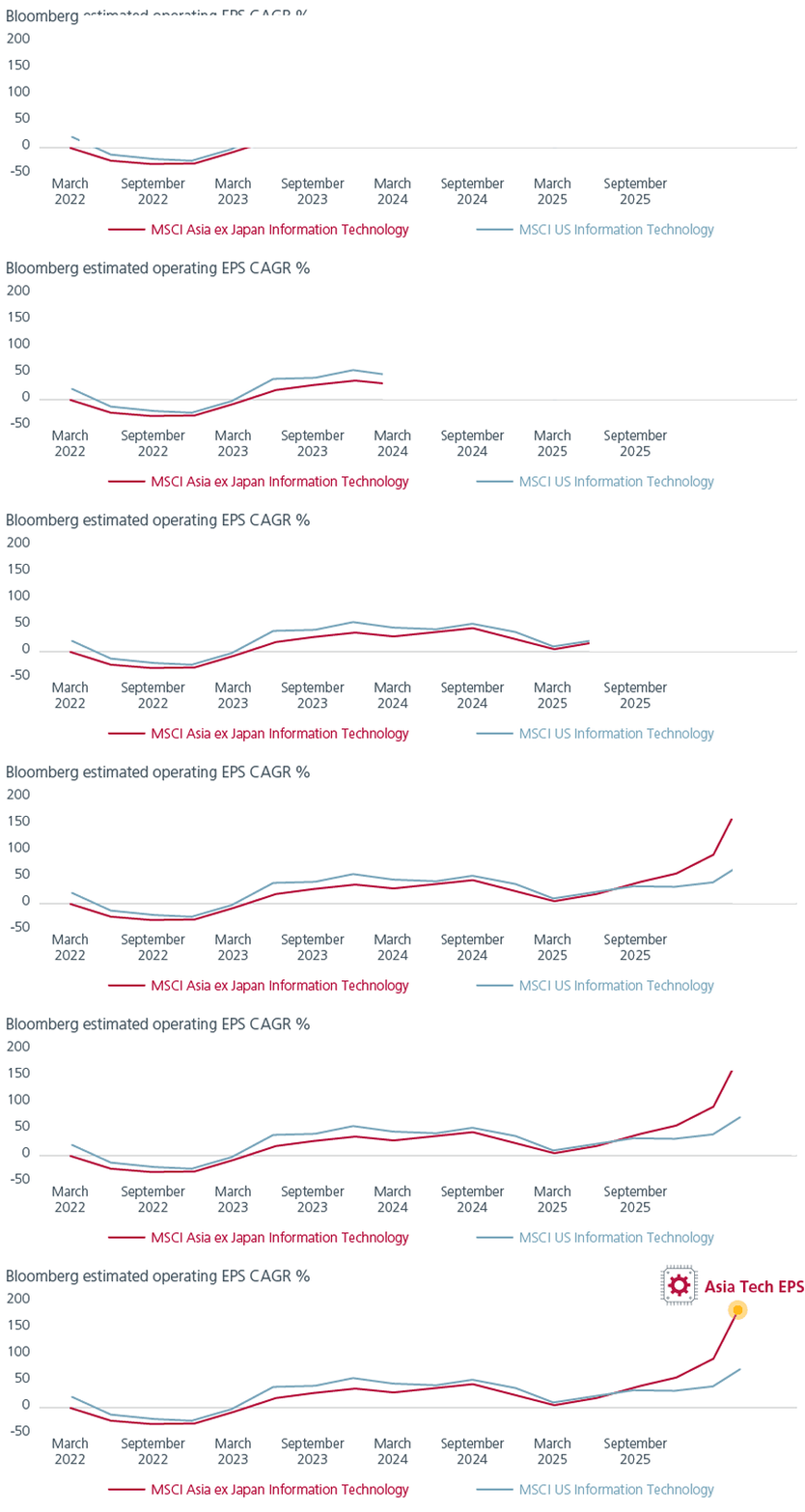
Source: Bloomberg. As of 29 May 2026.
How is Asia tech different from US tech?
Unlike US tech companies which are focused on developing AI models, cloud services and applications, Asia tech companies are AI enablers - supplying semiconductor chips, hardware and infrastructure that make AI deployment possible.
For example, within an AI server, Asian companies provide many critical components which US and European companies cannot supply including optical transceivers, cooling fans and modules, passive components, and server chassis. Asian companies also manufacture key parts for physical AI and robotics such as actuators, sensors and batteries.
Due to the distinct sector makeup of Asia’s tech sector compared to that of the United States, the MSCI AC Asia ex Japan Information Technology (IT) Index has a correlation below 0.6 with both the Nasdaq and the MSCI US IT Index. This unique positioning makes Asia tech stocks an attractive and complementary addition for investors who already hold US or global tech stocks.
Asia’s tech exposure is also diversified across multiple segments and markets, providing investors with a larger universe to extract alpha.
Fig. 3. Asia’s strength within the global AI ecosystem

Source: Eastspring Investments. BofA Research. May 2026.
With Asia’s tech sector spanning a wide range of segments, Asia tech stocks allow investors to participate in multiple themes beyond AI, such as EV/ Autonomous driving, Healthcare Tech, Payment, E-commerce and Digital Transformation, which we will explore in subsequent articles.
What is Asia’s edge in the AI supply chain?
Asia’s edge as the hardware backbone of the AI supply chain is grounded in deep expertise, a vibrant ecosystem, abundant and competitively priced workforce, and decades of intentional government policies alongside dynamic private sector entrepreneurship. As such, replicating Asia’s technology supply chain is not just a matter of capital investment but of rebuilding an entire ecosystem that has evolved over decades.
Deeply embedded eco-system - Asia’s technology supply chain is widely viewed as difficult to replicate because it is not a single capability, but a deeply embedded ecosystem built over decades. Across Asia, countries have developed highly complementary roles within a tightly integrated production network. The proximity between countries enables faster innovation cycles, rapid problem solving and continual process optimisation. This enables Asia tech companies to move nimbly, helping them to maintain their competitive edge and margins. Fig. 4.
Fig. 4. Example of global semiconductor supply chain

Source: BCG analysis with data from Gartner, SEMI, UBS; SPEEDA, Eastspring Investments.
Human capital & expertise - Human capital and accumulated expertise also represent significant barriers to replication. Asia’s decades-long experience in mass-producing high-precision components for consumer electronics has established a hard-to-match advantage in scale, precision, integration, and speed which Asia tech companies now leverage to produce complex components for AI-related infrastructure.
Long-term industrial policy - Asia’s supply chain has also been shaped by long-term industrial policy and coordinated investment. Governments across the region have supported infrastructure development, talent pipelines, and strategic industries over multiple decades, aligning public policy with private sector growth. While other regions are now pursuing reshoring and localisation strategies, these efforts face the challenge of replicating not just individual capabilities, but the full system of interdependencies that underpin Asia’s dominance.
Therefore, while the US has emerged as the dominant source of AI-related demand, Asia has consolidated its position as the primary AI production hub. Fig. 5 shows that AI-related goods make up a significant share of Asia’s total exports.
Fig. 5. AI-related goods as a share of total exports for selected Asia markets
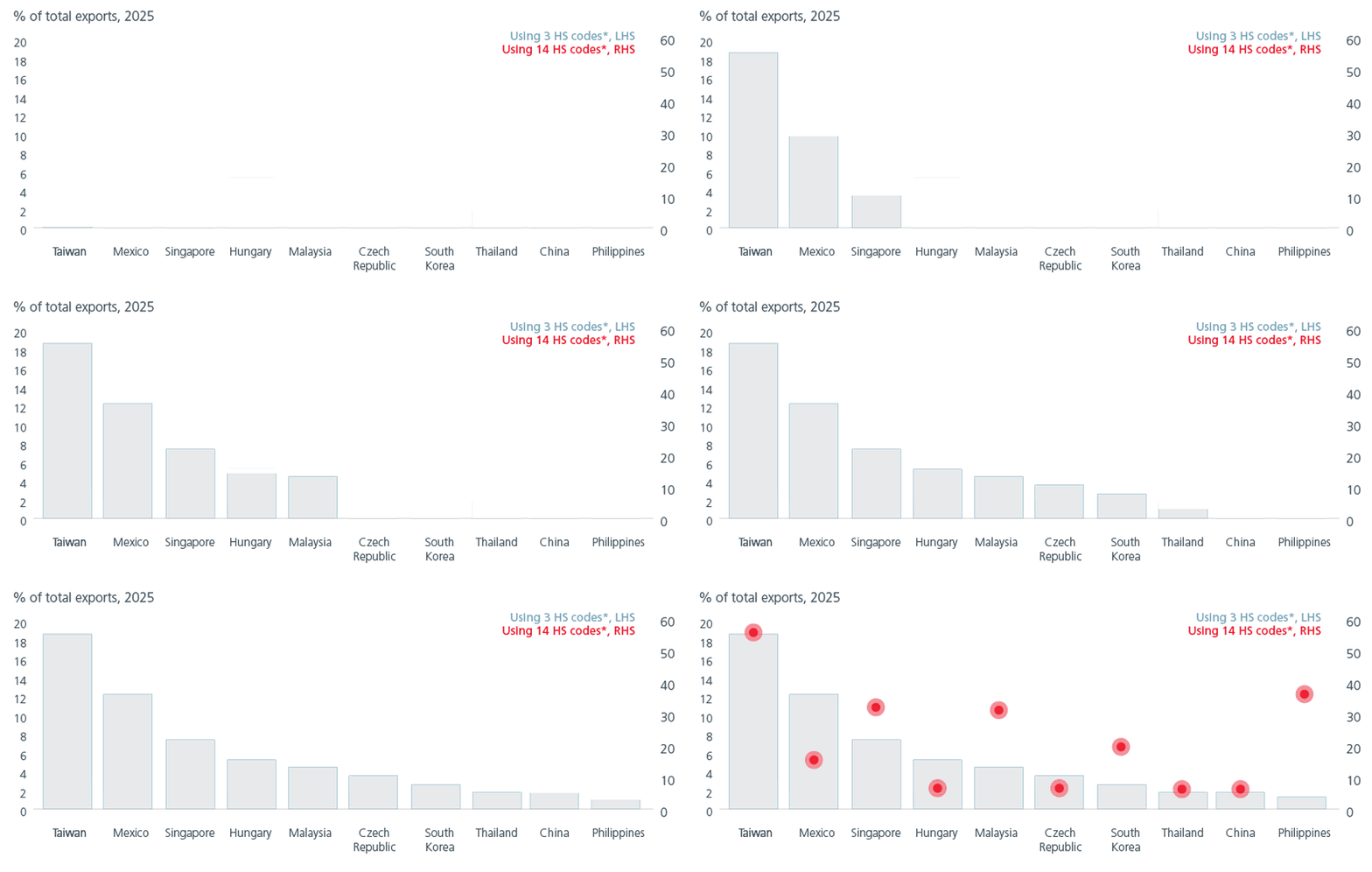
Source: UN Comtrade, IIF; China, Taiwan & S Korea figures are from 2024; Singapore figures are till Sep 2025; *World Customs Organisation Harmonised System Codes.
How can investors capture the AI opportunity?
The AI cycle is still at an early stage when compared to the 1990s technology cycle. Fig. 6. The global AI market is projected to grow from more than USD300bn in 2025 to nearly USD1.2 trn by 2030, according to forecasts by various research institutions. This could drive an estimated USD3-5 tr of cumulative AI investment, benefiting AI chips, AI infrastructure and the broader tech sector. Against this positive outlook, there are also challenges including power constraints for data centers, production bottlenecks and export controls for semiconductor chip and equipment, uncertainty over the pace of AI monetisation and adoption alongside privacy and security concerns as well as regulatory frameworks. Ultimately, success in capturing the benefits of the AI opportunity will depend on how effectively countries and companies navigate these challenges.
Fig. 6. The AI capex cycle is at an early stage

Source: BEA, IIF. The 1990s technology cycle is indexed to 1Q1993. The AI cycle is indexed to 1Q2022. Equipment and intellectual property investment as % share of nominal US GDP.
As the backbone of global AI ecosystem, Asia is set to remain a cornerstone of the global technology infrastructure. The region’s tech ecosystem is hard to replicate and valuations are attractive. With the US’ dominance (~76%) in global technology benchmarks, investors risk overlooking attractive opportunities and emerging innovators which a dedicated Asia tech allocation can offer.
This article is the second in a five‑part series on the AI technology cycle and the investment opportunities in Asia as the cycle evolves and matures. Explore the full series.
Look out for the next article Why Asia is central to the AI server build-out which examines Asia’s competitive advantage in the AI server ecosystem.
Interesting reads



Sources:
1 MSCI All Country Asia Pacific ex Japan Information Technology Index Index and MSCI All Country World Information Technology Index. In USD. As of 29 May 2026.
Singapore by Eastspring Investments (Singapore) Limited (UEN: 199407631H)
Australia (for wholesale clients only) by Eastspring Investments (Singapore) Limited (UEN: 199407631H), which is incorporated in Singapore, is exempt from the requirement to hold an Australian financial services licence and is licensed and regulated by the Monetary Authority of Singapore under Singapore laws which differ from Australian laws
Hong Kong by Eastspring Investments (Hong Kong) Limited and has not been reviewed by the Securities and Futures Commission of Hong Kong.
Indonesia by PT Eastspring Investments Indonesia, an investment manager that is licensed, registered and supervised by the Indonesia Financial Services Authority (OJK).
Malaysia by Eastspring Investments Berhad (200001028634/ 531241-U) and Eastspring Al-Wara’ Investments Berhad (200901017585 / 860682-K) and has not been reviewed by Securities Commission of Malaysia.
Thailand by Eastspring Asset Management (Thailand) Co., Ltd.
United States of America (for institutional clients only) by Eastspring Investments (Singapore) Limited (UEN: 199407631H), which is incorporated in Singapore and is registered with the U.S Securities and Exchange Commission as a registered investment adviser.
European Economic Area (for professional clients only) and Switzerland (for qualified investors only) by Eastspring Investments (Luxembourg) S.A., 26, Boulevard Royal, 2449 Luxembourg, Grand-Duchy of Luxembourg, registered with the Registre de Commerce et des Sociétés (Luxembourg), Register No B 173737.
Chile (for institutional clients only) by Eastspring Investments (Singapore) Limited (UEN: 199407631H), which is incorporated in Singapore and is licensed and regulated by the Monetary Authority of Singapore under Singapore laws which differ from Chilean laws.
The afore-mentioned entities are hereinafter collectively referred to as Eastspring Investments.
The views and opinions contained herein are those of the author, and may not necessarily represent views expressed or reflected in other Eastspring Investments’ communications. This document is solely for information purposes and does not have any regard to the specific investment objective, financial situation and/or particular needs of any specific persons who may receive this document. This document is not intended as an offer, a solicitation of offer or a recommendation, to deal in shares of securities or any financial instruments. It may not be published, circulated, reproduced or distributed without the prior written consent of Eastspring Investments. Reliance upon information in this document is at the sole discretion of the reader. Please carefully study the related information and/or consult your own professional adviser before investing.
Investment involves risks. Past performance of and the predictions, projections, or forecasts on the economy, securities markets or the economic trends of the markets are not necessarily indicative of the future or likely performance of Eastspring Investments or any of the funds managed by Eastspring Investments.
Information herein is believed to be reliable at time of publication. Data from third party sources may have been used in the preparation of this material and Eastspring Investments has not independently verified, validated or audited such data. Where lawfully permitted, Eastspring Investments does not warrant its completeness or accuracy and is not responsible for error of facts or opinion nor shall be liable for damages arising out of any person’s reliance upon this information. Any opinion or estimate contained in this document may subject to change without notice.
Eastspring Investments companies (excluding joint venture companies) are ultimately wholly owned/indirect subsidiaries of Prudential plc of the United Kingdom. Eastspring Investments companies (including joint venture companies) and Prudential plc are not affiliated in any manner with Prudential Financial, Inc., a company whose principal place of business is in the United States of America or with the Prudential Assurance Company Limited, a subsidiary of M&G plc (a company incorporated in the United Kingdom).