






Oct 2026|5 min read



Executive Summary
Singapore bonds have not been immune to the recent global repricing in yields, but the broader investment case remains anchored in quality, resilience and diversification. This Q&A helps explain what has been driving the market, where opportunities may still exist, and why quality and selectivity matter in today’s environment.
Q1. Why have Singapore bond yields been volatile recently?
Singapore government bond yields have risen alongside global yields, driven by resilient global growth and supply-shock inflation, stemming from higher energy prices amid the ongoing Middle East conflict. Markets have consequently shifted beyond paring expectations for monetary easing to pricing in rate hikes across major central banks and some emerging-market economies. Meanwhile, strong capital demand from hyperscalers investing in AI infrastructure, together with elevated government borrowing to finance sizeable fiscal deficits has intensified competition for long-term funding, adding to upward pressure on yields and volatility, particularly at the long end.
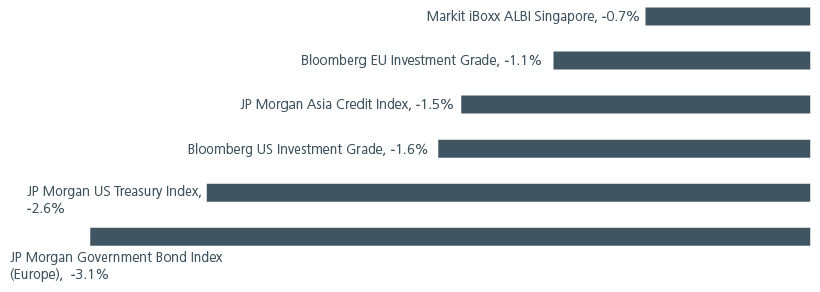
Year to date, SGD bonds have remained resilient and are only modestly down by -0.7%1, outperforming comparable bond segments, including US Treasuries, US and Euro Investment Grade corporate bonds (in local currency terms). Fig 1.
Fig 1. YTD total returns in local currency of comparable bond indices
Source: Bloomberg as of 30 September 2026, in local currency terms. The use of indices as proxies for the past performance of any asset class/sector is limited and should not be construed as being indicative of future performance. The chart above is included for illustrative purposes only and may not be indicative of the future or likely performance of the markets.
Within SGD bonds, quasi sovereigns and IG corporate bonds outperformed, beneffting from their shorter duration relative to Singapore government bonds.
Q2. What is the outlook for the Singapore economy and for interest rates?
Singapore’s economy remains resilient, supported by strong electronics exports and artificial intelligence-related manufacturing activity. Singapore’s Ministry of Trade and Industry raised Singapore’s 2026 growth forecast to 4.5% to 5.5% from 2.0% to 4.0% in August. Meanwhile, inflation is expected to remain contained at 2.1%2. However, stronger growth could keep policymakers vigilant, and markets may price in further policy tightening should growth or inflation surprise on the upside.
If the Monetary Authority of Singapore (MAS) tightens the SGD Nominal Effective Exchange Rate (NEER), allowing the SGD to appreciate faster, this will lower import prices and dampen domestic inflation. A faster-appreciating SGD NEER implies lower SGD interest rates relative to USD and global rates, as the currency appreciation compensates investors for the rate differential. Broadly, short-end SGD rates are influenced more by domestic liquidity conditions while longer-dated SGD bond yields will be influenced by global yields although the SGD NEER acts as a partial buffer. A faster-appreciating SGD NEER also drives demand for SGD assets, including SGD bonds.
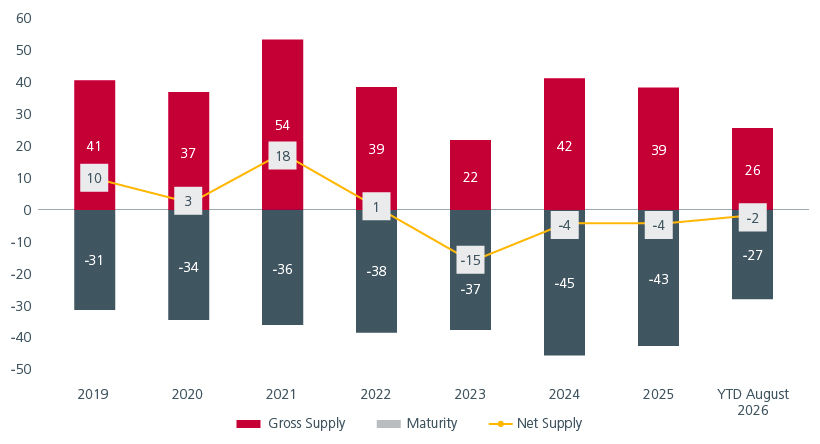
From a technical perspective, the SGD bond market should also continue to benefit from the net negative supply trend which is in its 4th consecutive year. Fig 2.
Fig 2. SGD bond market net supply (S$ billion)
Source: Eastspring Investments, extracted from Bloomberg on end August 2026, excluding T-bills and bonds that are smaller than SGD100m. The chart above is included for illustrative purposes only and may not be indicative of the future or likely performance of the markets.
Q3. What do you like in Singapore fixed income today?
SGD bonds generally have lower volatility and a better risk-return profile compared to USD bonds. We continue to see merit in high-quality Singapore dollar (SGD) credit, particularly investment grade corporate and quasi-sovereign bonds. These tend to have relatively shorter duration and offer a yield pick-up when compared against Singapore government bonds. We currently have a neutral duration stance but remain agile on duration management given evolving interest rate expectations globally.
While markets currently have a bearish view on duration, a faster than expected resolution to the Middle East confliction and subsequent moderation in energy prices could ease inflationary pressures and support a rebound in the bond market.
Q4. What risks should investors be aware of going forward?
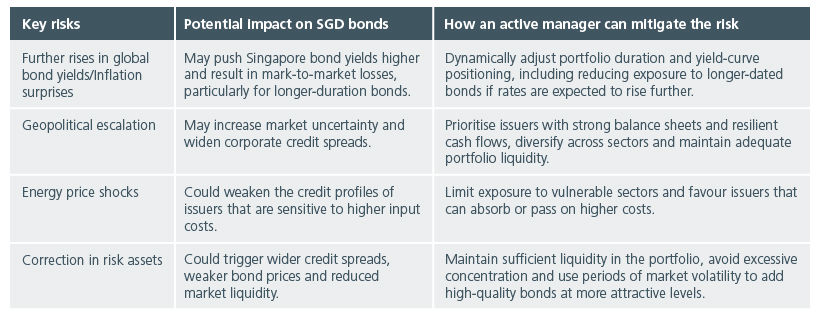
The main risks include further rises in global bond yields, inflation surprises, geopolitical escalation, energy price shocks and any sharp correction in risk assets. These factors could contribute to further volatility in SGD bonds, even if the underlying credit fundamentals remain sound.
An active manager can help to mitigate these risks through flexible duration and yield-curve positioning and selective exposure to issuers with sound balance sheets and resilient cash flows. The manager can also diversify across maturities and sectors, maintain liquidity and use periods of market volatility to add high-quality bonds to the portfolio at more attractive yields. Fig. 3.
Fig. 3. Key risks and mitigating factors
Source: Eastspring Investments. September 2026.
Q5. Why should investors stay invested or consider investing in Singapore dollar bonds?
Although SGD bonds are not immune to global rate movements, they have historically been a source of defensive income and diversification in portfolios. SGD bonds have delivered annualized returns of 5.1% over the last 3 years3.
Their appeal is underpinned by:
- Singapore’s strong sovereign fundamentals - Singapore is one of only 10 AAA-rated countries in the world.
- Supportive demand-supply dynamics – There is resilient institutional demand for SGD bonds as assets managed by institutions (eg insurance companies) in Singapore continue to grow.
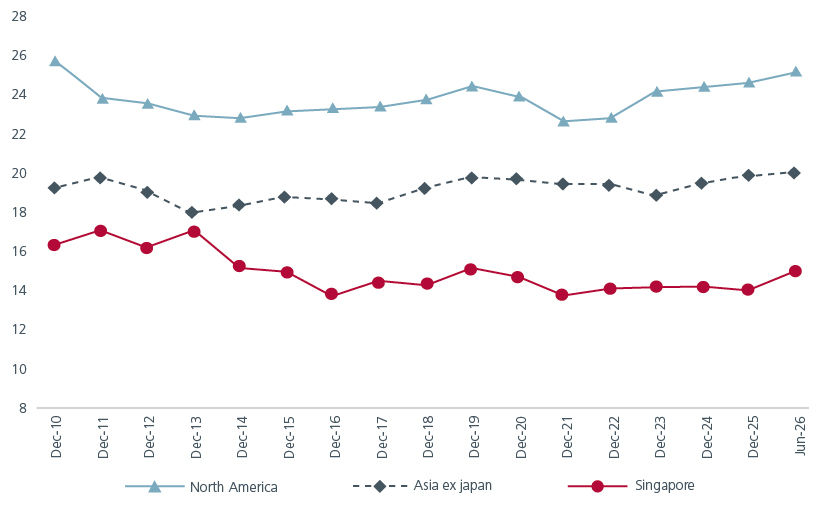
- Relatively robust balance sheets of Singapore corporates and banks - The total debt to asset ratio of Singapore companies is superior to that of North American and other Asian companies. Fig. 4. This should help to keep the default risk of Singapore corporate bonds low.
Fig. 4. Total debt to asset ratio (%)
Bloomberg, MSCI as of 30 June 2026, debt to total asset ratios proxied by respective regional and country MSCI indices.
For SGD-based investors, investing in domestic currency bonds reduces the foreign exchange risk and hedging costs associated with overseas bond allocations.
For existing investors, the key message is that although SGD bonds have not been immune to the global sell-off, they have generally shown lower sensitivity to US rates. In other words, the recent price action in SGD bonds has been more a function of the repricing in global rates than a breakdown in the SGD bond or Asia Fixed Income story.
For prospective investors, the correction has materially improved the forward-looking income opportunity. The same rise in yields that created short-term mark-to-market pressure has also resulted in more attractive starting nominal yields, real rates and carry for investors allocating to SGD bonds today.
Interesting reads









Sources:
1As of 30 September 2026. Benchmark is the Markit iBoxx ALBI Singapore Index. In SGD terms.
2CPI-All items inflation: September Monetary Authority of Singapore survey.
3As of 31 August 2026. Benchmark is the Markit iBoxx ALBI Singapore Index. In SGD terms.
This document is produced by Eastspring Investments (Singapore) Limited and issued in:
Singapore by Eastspring Investments (Singapore) Limited (UEN: 199407631H)
Australia (for wholesale clients only) by Eastspring Investments (Singapore) Limited (UEN: 199407631H), which is incorporated in Singapore, is exempt from the requirement to hold an Australian financial services licence and is licensed and regulated by the Monetary Authority of Singapore under Singapore laws which differ from Australian laws
Hong Kong by Eastspring Investments (Hong Kong) Limited and has not been reviewed by the Securities and Futures Commission of Hong Kong.
Indonesia by PT Eastspring Investments Indonesia, an investment manager that is licensed, registered and supervised by the Indonesia Financial Services Authority (OJK).
Malaysia by Eastspring Investments Berhad (200001028634/ 531241-U) and Eastspring Al-Wara’ Investments Berhad (200901017585 / 860682-K) and has not been reviewed by Securities Commission of Malaysia.
Thailand by Eastspring Asset Management (Thailand) Co., Ltd.
United States of America (for institutional clients only) by Eastspring Investments (Singapore) Limited (UEN: 199407631H), which is incorporated in Singapore and is registered with the U.S Securities and Exchange Commission as a registered investment adviser.
European Economic Area (for professional clients only) and Switzerland (for qualified investors only) by Eastspring Investments (Luxembourg) S.A., 26, Boulevard Royal, 2449 Luxembourg, Grand-Duchy of Luxembourg, registered with the Registre de Commerce et des Sociétés (Luxembourg), Register No B 173737.
Chile (for institutional clients only) by Eastspring Investments (Singapore) Limited (UEN: 199407631H), which is incorporated in Singapore and is licensed and regulated by the Monetary Authority of Singapore under Singapore laws which differ from Chilean laws.
The afore-mentioned entities are hereinafter collectively referred to as Eastspring Investments.
The views and opinions contained herein are those of the author, and may not necessarily represent views expressed or reflected in other Eastspring Investments’ communications. This document is solely for information purposes and does not have any regard to the specific investment objective, financial situation and/or particular needs of any specific persons who may receive this document. This document is not intended as an offer, a solicitation of offer or a recommendation, to deal in shares of securities or any financial instruments. It may not be published, circulated, reproduced or distributed without the prior written consent of Eastspring Investments. Reliance upon information in this document is at the sole discretion of the reader. Please carefully study the related information and/or consult your own professional adviser before investing.
Investment involves risks. Past performance of and the predictions, projections, or forecasts on the economy, securities markets or the economic trends of the markets are not necessarily indicative of the future or likely performance of Eastspring Investments or any of the funds managed by Eastspring Investments.
Information herein is believed to be reliable at time of publication. Data from third party sources may have been used in the preparation of this material and Eastspring Investments has not independently verified, validated or audited such data. Where lawfully permitted, Eastspring Investments does not warrant its completeness or accuracy and is not responsible for error of facts or opinion nor shall be liable for damages arising out of any person’s reliance upon this information. Any opinion or estimate contained in this document may subject to change without notice.
Eastspring Investments companies (excluding joint venture companies) are ultimately wholly owned/indirect subsidiaries of Prudential plc of the United Kingdom. Eastspring Investments companies (including joint venture companies) and Prudential plc are not affiliated in any manner with Prudential Financial, Inc., a company whose principal place of business is in the United States of America or with the Prudential Assurance Company Limited, a subsidiary of M&G plc (a company incorporated in the United Kingdom).