





Apr 2026|5 min read


Executive Summary
- In the current uncertain environment, durable income from equity dividends has become increasingly important; in Asia, dividends have been a reliable contributor to long‑term equity returns.
- Durable income, however, offers little protection if capital is hit by deep drawdowns which is why managing volatility is as essential in a strategy as the dividend discipline itself.
- Staying invested, not timing the market, unlocks the power of compounding, while defensive diversification helps to stabilise portfolios during drawdowns.
Markets have entered a period of heightened volatility as the war in the Middle East raises concerns over energy supply, economic spillovers, and the diverging views on central bank policy. In this environment, the defensive characteristics of low volatility strategies have provided meaningful downside protection; through March 2026, the Asia Pacific ex Japan Minimum Volatility index1 outperformed the broader Asia market by 2.6% while the Global Low Volatility index2 outperformed the broader global market by 2.0%.
Against this backdrop, balancing income, growth and portfolio resilience has become more challenging. Cash yields are increasingly uncertain with the war risking a reigniting of inflation and clouding the rate outlook just as markets had begun to price in easing. Regardless of whether rates fall, hold or rise, the case for durable income from equity dividends has strengthened.
At this juncture, an equity strategy that provides income with less volatility offers a smoother investment journey and helps investors remain invested and benefit from long‑term compounding.
Dividends: A key pillar of long‑term performance
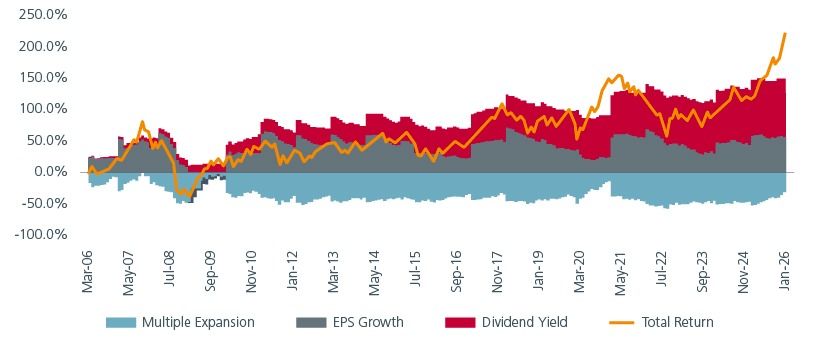
In Asia, dividend yield has been a foundational pillar of long‑term wealth creation. A decomposition of returns for the MSCI Asia Pacific ex‑Japan Index from March 2006 to February 2026 reveals three distinct drivers: earnings growth, valuation changes through multiple expansion or contraction, and dividends. See Fig 1.
While valuation multiples can be highly volatile, swinging sharply between expansion and contraction and acting as both a tailwind and a headwind at different points in the cycle, earnings growth has been comparatively more consistent but remains subject to cyclical variation. Meanwhile the dividend component has delivered the most reliable and steadily compounding contribution to total returns over time.
Fig 1: Decomposition of total returns of the MSCI AC Asia Pacific ex Japan index
Source: Eastspring Investments, MSCI indices, Bloomberg, as of 27 February 2026
A strategy that systematically targets companies with attractive and sustainable dividend yields is therefore not merely seeking income; it is harnessing one of the region’s most reliable sources of total return.
That said, even durable income can be undermined if capital is eroded by severe drawdowns. A portfolio yielding 6% offers little comfort to an investor whose capital base has just fallen by 30%. This is why the second dimension of the strategy, managing volatility, is as critical as the dividend discipline that underpins it.
Volatility: Why managing the downside matters more than chasing the upside
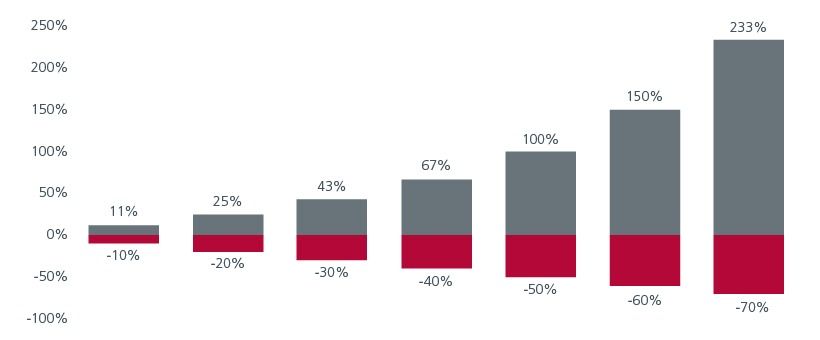
The mathematics of loss recovery are well understood by investors. A stock that falls by 50% must subsequently rise by 100% to break even. See Fig 2. This asymmetry i.e. where losses compound far more painfully than gains, is the single most important reason why managing volatility is critical to long‑term wealth creation.
Fig 2: After a sell off, a greater rise is needed to break even
Source: Eastspring Investments
In practice, however, the real‑world consequences of this return asymmetry are even more dramatic than simple arithmetic suggests. Consider the following striking comparison.
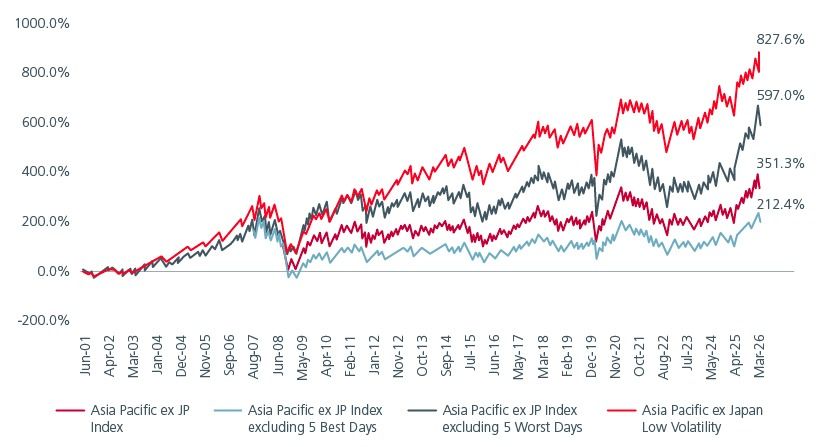
From 1 June 2001 to 20 March 2026, the MSCI AC Asia Pacific ex Japan index delivered a cumulative return of approximately 351%. See Fig 3. Remove just the five worst trading days from the entire period, and the cumulative return rises sharply to around 597%, roughly 70% higher. Conversely, if an investor were to miss the five best days, cumulative returns fall to approximately 212%, some 40% lower.
Fig 3: Asia Pacific ex JP market performance when missing the best/worst 5 days
Source: Eastspring Investments, MSCI indices, Bloomberg, as of 20 March 2026
These figures reveal an uncomfortable truth for investors: a handful of extreme trading sessions, just five days out of more than six thousand, can materially alter long‑term investment outcomes. Crucially, the best and worst days tend to cluster around periods of crisis and recovery, making them all but impossible to time consistently.
The key question is not whether these days can be predicted - they cannot - but whether portfolios can be built to withstand them. This is where low volatility adds value from a portfolio construction perspective.
Over the same period (1 June 2001 to 20 March 2026), the MSCI Asia Pacific ex‑Japan Low Volatility Index delivered a cumulative return of approximately 827%, substantially outperforming the broader market’s 351% and even exceeding a scenario where the market avoided its five worst trading days. This is a powerful reminder that staying fully invested even through periods of sell offs, rather than attempting to time the market, can deliver superior long‑term outcomes. The power of compounding, when supported by a smoother return path, is extraordinary.
Building resilience through defensive diversification
Markets will always be uncertain. Tariff disputes, geopolitical tensions and shifts in central bank policy may dominate the headlines, but volatility will be a constant. In such an environment, the objective is not to attempt to predict the next shock, but to build portfolios that are designed to withstand one.
This elevates the importance of diversification, not simply across asset classes, but within equities through genuinely defensive exposures. When drawdowns are swift and correlations rise is precisely when diversification is most needed; investors benefit from allocations that stabilise overall portfolio outcomes.
Defensive strategies are not about opting out of growth; rather, they are about participating in long‑term equity returns while reducing the behavioural and compounding damage caused by severe drawdowns. Incorporating lower‑volatility, income‑generating equities can help balance portfolios across market regimes, supporting resilience without sacrificing participation in the upside.
Ultimately, defensive diversification serves a simple but powerful purpose, helping investors stay invested. And in an uncertain world, staying invested, through every shock, sell off and recovery, remains the most dependable path to long‑term wealth creation.
Interesting reads








Sources:
1 As represented by MSCI AC Asia Pacific ex Japan Min Vol index and the Asia market refers to MSCI AC Asia Pacific ex Japan Index, as of 20 March 2026.
2 As represented by MSCI AC World Min Vol index and the global market refers to MSCI AC World Index, as of 20 March 2026.
Singapore by Eastspring Investments (Singapore) Limited (UEN: 199407631H)
Australia (for wholesale clients only) by Eastspring Investments (Singapore) Limited (UEN: 199407631H), which is incorporated in Singapore, is exempt from the requirement to hold an Australian financial services licence and is licensed and regulated by the Monetary Authority of Singapore under Singapore laws which differ from Australian laws
Hong Kong by Eastspring Investments (Hong Kong) Limited and has not been reviewed by the Securities and Futures Commission of Hong Kong.
Indonesia by PT Eastspring Investments Indonesia, an investment manager that is licensed, registered and supervised by the Indonesia Financial Services Authority (OJK).
Malaysia by Eastspring Investments Berhad (200001028634/ 531241-U) and Eastspring Al-Wara’ Investments Berhad (200901017585 / 860682-K) and has not been reviewed by Securities Commission of Malaysia.
Thailand by Eastspring Asset Management (Thailand) Co., Ltd.
United States of America (for institutional clients only) by Eastspring Investments (Singapore) Limited (UEN: 199407631H), which is incorporated in Singapore and is registered with the U.S Securities and Exchange Commission as a registered investment adviser.
European Economic Area (for professional clients only) and Switzerland (for qualified investors only) by Eastspring Investments (Luxembourg) S.A., 26, Boulevard Royal, 2449 Luxembourg, Grand-Duchy of Luxembourg, registered with the Registre de Commerce et des Sociétés (Luxembourg), Register No B 173737.
Chile (for institutional clients only) by Eastspring Investments (Singapore) Limited (UEN: 199407631H), which is incorporated in Singapore and is licensed and regulated by the Monetary Authority of Singapore under Singapore laws which differ from Chilean laws.
The afore-mentioned entities are hereinafter collectively referred to as Eastspring Investments.
The views and opinions contained herein are those of the author, and may not necessarily represent views expressed or reflected in other Eastspring Investments’ communications. This document is solely for information purposes and does not have any regard to the specific investment objective, financial situation and/or particular needs of any specific persons who may receive this document. This document is not intended as an offer, a solicitation of offer or a recommendation, to deal in shares of securities or any financial instruments. It may not be published, circulated, reproduced or distributed without the prior written consent of Eastspring Investments. Reliance upon information in this document is at the sole discretion of the reader. Please carefully study the related information and/or consult your own professional adviser before investing.
Investment involves risks. Past performance of and the predictions, projections, or forecasts on the economy, securities markets or the economic trends of the markets are not necessarily indicative of the future or likely performance of Eastspring Investments or any of the funds managed by Eastspring Investments.
Information herein is believed to be reliable at time of publication. Data from third party sources may have been used in the preparation of this material and Eastspring Investments has not independently verified, validated or audited such data. Where lawfully permitted, Eastspring Investments does not warrant its completeness or accuracy and is not responsible for error of facts or opinion nor shall be liable for damages arising out of any person’s reliance upon this information. Any opinion or estimate contained in this document may subject to change without notice.
Eastspring Investments companies (excluding joint venture companies) are ultimately wholly owned/indirect subsidiaries of Prudential plc of the United Kingdom. Eastspring Investments companies (including joint venture companies) and Prudential plc are not affiliated in any manner with Prudential Financial, Inc., a company whose principal place of business is in the United States of America or with the Prudential Assurance Company Limited, a subsidiary of M&G plc (a company incorporated in the United Kingdom).