







Hi, how can I assist?
Give me a summary of the article
AI server demand is supported by rising AI adoption, growing inference workloads and continued investment in data centres.
Asia's deep manufacturing capabilities and integrated supply chains make it the backbone of the global AI server ecosystem.
Investors should focus on areas of the AI stack with the strongest pricing power as value shifts, making active investing essential.
While AI exuberance has focused on compute chips, the underlying build out is broader and more fundamentally anchored in infrastructure. The AI infrastructure market has consistently sustained high double-digit growth in recent years. According to International Data Corporation (IDC), it is projected to reach USD758 billion by 2029, driven primarily by investment in AI servers.1 This is because the process starts at the server level.
A single server combines compute, control, memory, storage, networking, power and cooling stacked in a vertically integrated structure that enables greater density, efficiency and scalability. A data centre consists of thousands of server stacks; as per IDC, servers accounted for 98% of the total AI spending in 2Q25, growing 173.2% on a year-on-year basis.
What is the growth outlook for AI servers?
Traditional servers which are built around central processing units (CPU) are best for sequential tasks. In contrast, AI servers leverage graphics processing units (GPUs) to process thousands of operations simultaneously, allowing complex workloads to be completed faster and at much larger scale.
AI server demand will be supported by a) rising AI adoption across industries such as healthcare, retail, finance, automotive etc. b) hyperscalers continuing to invest to maintain market position and capture future growth, and c) sovereign AI mandates with governments increasingly investing in AI research and development.
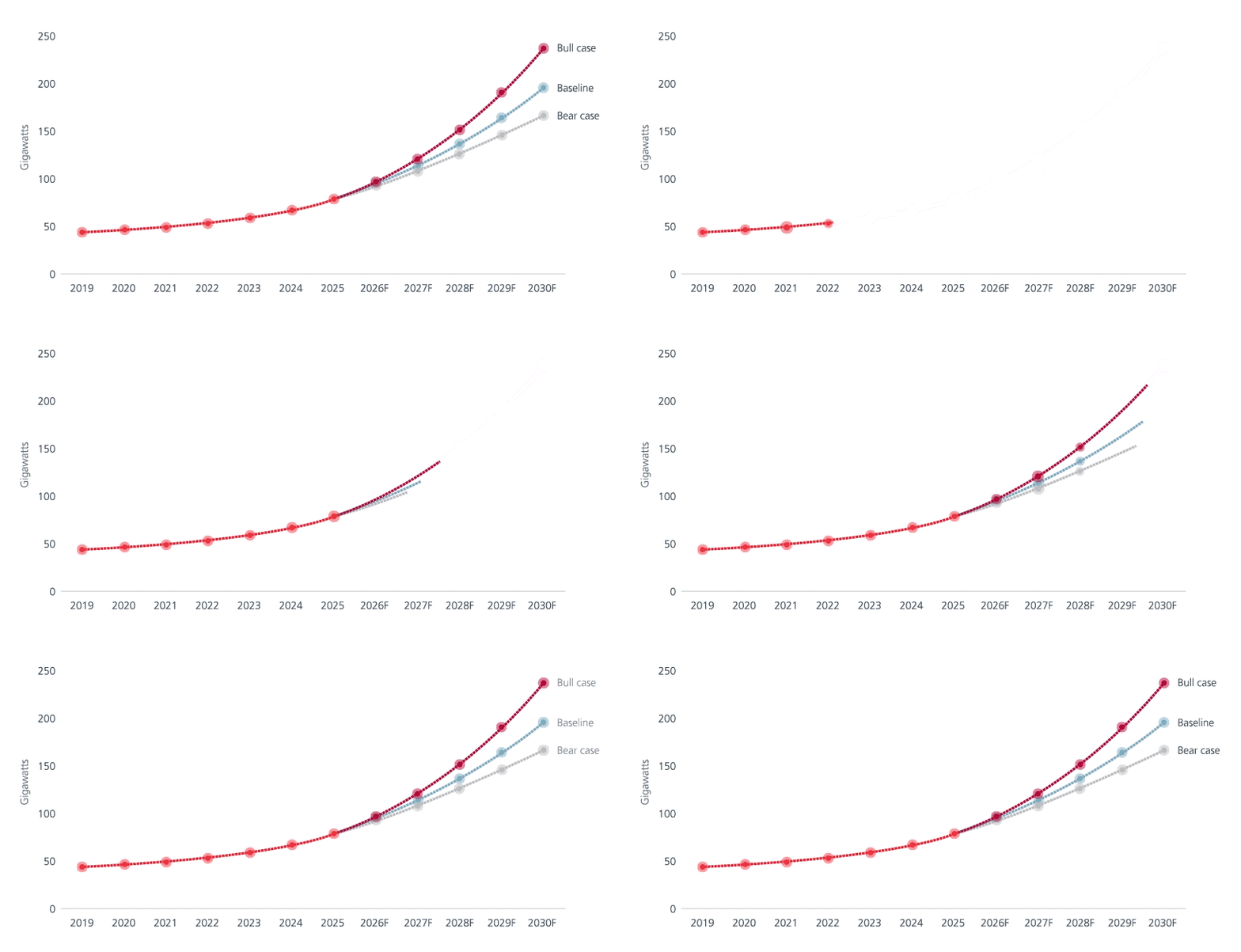
As AI adoption broadens, inference is expected to become an increasingly important driver of compute demand. Unlike training, which is periodic, inference requires ongoing processing each time AI applications are used, supporting sustained investment in data centres.
Fig 1. Global data centre capacity could triple by 2030 as AI adoption accelerates
Source: Bain Data Centre Model, January 2026.
Why does AI infrastructure depend on Asia?
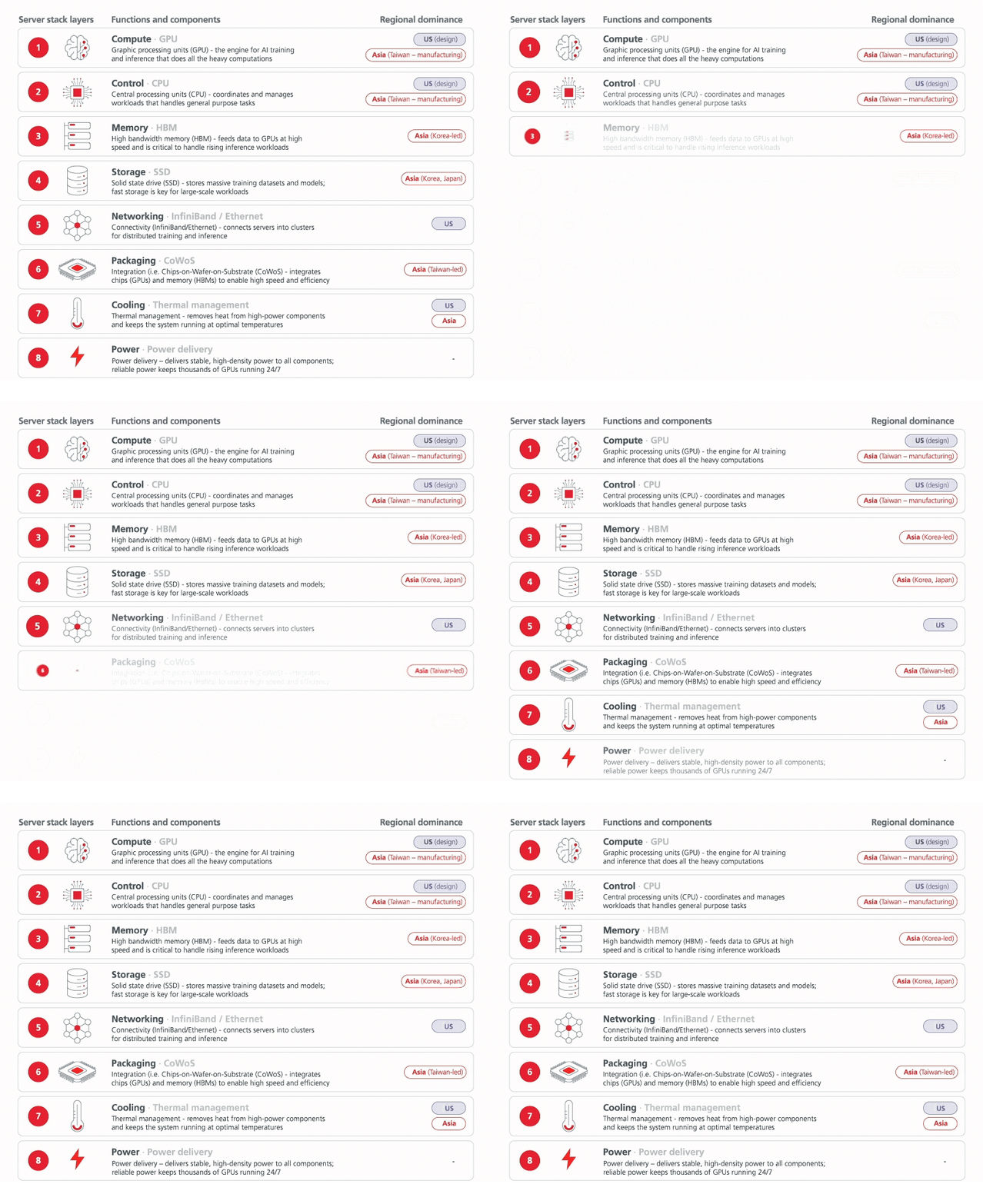
Asia's advantage in AI servers stems from its ability to supply critical components, deep manufacturing and assembly capabilities, and integrated supply chains that enable rapid scaling as AI demand accelerates. The ecosystem is highly interconnected, with Taiwan leading manufacturing and advanced packaging, South Korea dominating memory, Japan providing critical materials and equipment, Southeast Asia supporting assembly and deployment, and China contributing components and manufacturing scale.
Fig 2. Asia's dominance across the AI server supply chain: Leadership from compute to advanced packaging
Source: Eastspring Investments. June 2026.
The highest economic value often sits in US chip design and compute. Nevertheless, Asia too captures significant value across the AI server stack. Beyond its leadership in foundry manufacturing, memory and packaging, it remains deeply embedded in assembly and system integration, which are becoming increasingly sophisticated as AI servers evolve towards rack-scale architectures, liquid cooling and higher-density interconnectivity.
Importantly, this ecosystem has been built over decades, creating scale, expertise and supplier networks that are difficult to replicate. While the US leads in chip design, software and cloud platforms, and Europe retains strengths in equipment and materials, neither has matched Asia's breadth across the AI server value chain. Other regions may benefit from growing data centre investment but remain less developed in semiconductor and AI server supply chains. As a result, Asia remains central to the global AI infrastructure build out.
How can investors navigate shifting value across the AI stack?
The different components of the server stack will gain or lose economic value over time. It is thus important to monitor how value is redistributed across the server stack as the industry evolves. CPUs have already ceded importance to GPUs, while custom chips are beginning to take share from GPUs. Meanwhile, HBMs, advanced packaging and interconnect technologies are emerging as critical bottlenecks. Rather than disappearing, value is likely to shift towards the layers that remain essential to improving performance and efficiency.
For investors, the challenge is identifying where pricing power exists. Selectivity matters as not every company exposed to AI servers will benefit equally. Some companies may capture volume growth, but margins may remain under pressure. By contrast, areas such as memory, advanced foundry and packaging, interconnects, power and cooling could enjoy stronger pricing power if bottlenecks persist.
Ultimately, the durability of AI server demand will depend on successful AI monetisation. As AI adoption broadens and inference workloads grow, infrastructure demand becomes increasingly tied to usage rather than speculative investment. At the same time, the pace of adoption is increasingly constrained by physical infrastructure, with power emerging as the most critical bottleneck. Together, rising AI utilisation and infrastructure constraints support a multi-year build out cycle with Asia at the centre of this physical infrastructure build out.
This article is the third in a five‑part series on the AI technology cycle and the investment opportunities in Asia as the cycle evolves and matures. Explore the full series.
Look out for the next article “Why the shift to edge AI favours Asia” which explores Asia's edge AI advantage.
Interesting reads



Sources:
1 https://my.idc.com/getdoc.jsp?containerId=prUS53894425
Singapore by Eastspring Investments (Singapore) Limited (UEN: 199407631H)
Australia (for wholesale clients only) by Eastspring Investments (Singapore) Limited (UEN: 199407631H), which is incorporated in Singapore, is exempt from the requirement to hold an Australian financial services licence and is licensed and regulated by the Monetary Authority of Singapore under Singapore laws which differ from Australian laws
Hong Kong by Eastspring Investments (Hong Kong) Limited and has not been reviewed by the Securities and Futures Commission of Hong Kong.
Indonesia by PT Eastspring Investments Indonesia, an investment manager that is licensed, registered and supervised by the Indonesia Financial Services Authority (OJK).
Malaysia by Eastspring Investments Berhad (200001028634/ 531241-U) and Eastspring Al-Wara’ Investments Berhad (200901017585 / 860682-K) and has not been reviewed by Securities Commission of Malaysia.
Thailand by Eastspring Asset Management (Thailand) Co., Ltd.
United States of America (for institutional clients only) by Eastspring Investments (Singapore) Limited (UEN: 199407631H), which is incorporated in Singapore and is registered with the U.S Securities and Exchange Commission as a registered investment adviser.
European Economic Area (for professional clients only) and Switzerland (for qualified investors only) by Eastspring Investments (Luxembourg) S.A., 26, Boulevard Royal, 2449 Luxembourg, Grand-Duchy of Luxembourg, registered with the Registre de Commerce et des Sociétés (Luxembourg), Register No B 173737.
Chile (for institutional clients only) by Eastspring Investments (Singapore) Limited (UEN: 199407631H), which is incorporated in Singapore and is licensed and regulated by the Monetary Authority of Singapore under Singapore laws which differ from Chilean laws.
The afore-mentioned entities are hereinafter collectively referred to as Eastspring Investments.
The views and opinions contained herein are those of the author, and may not necessarily represent views expressed or reflected in other Eastspring Investments’ communications. This document is solely for information purposes and does not have any regard to the specific investment objective, financial situation and/or particular needs of any specific persons who may receive this document. This document is not intended as an offer, a solicitation of offer or a recommendation, to deal in shares of securities or any financial instruments. It may not be published, circulated, reproduced or distributed without the prior written consent of Eastspring Investments. Reliance upon information in this document is at the sole discretion of the reader. Please carefully study the related information and/or consult your own professional adviser before investing.
Investment involves risks. Past performance of and the predictions, projections, or forecasts on the economy, securities markets or the economic trends of the markets are not necessarily indicative of the future or likely performance of Eastspring Investments or any of the funds managed by Eastspring Investments.
Information herein is believed to be reliable at time of publication. Data from third party sources may have been used in the preparation of this material and Eastspring Investments has not independently verified, validated or audited such data. Where lawfully permitted, Eastspring Investments does not warrant its completeness or accuracy and is not responsible for error of facts or opinion nor shall be liable for damages arising out of any person’s reliance upon this information. Any opinion or estimate contained in this document may subject to change without notice.
Eastspring Investments companies (excluding joint venture companies) are ultimately wholly owned/indirect subsidiaries of Prudential plc of the United Kingdom. Eastspring Investments companies (including joint venture companies) and Prudential plc are not affiliated in any manner with Prudential Financial, Inc., a company whose principal place of business is in the United States of America or with the Prudential Assurance Company Limited, a subsidiary of M&G plc (a company incorporated in the United Kingdom).