






Oct 2026|5 min read



Executive Summary
Higher bond yields and Asia’s strong equity rally may cause investors to reassess dividend strategies, but we show that a forward-looking approach to Asian equity income can access three complementary return engines: stable income, growing dividends and recovering payouts to achieve attractive total returns for investors.
Dividends are a journey
What do a Chinese truck-engine manufacturer, a Taiwanese semiconductor-services company and a Singapore telecommunications group have in common? At first glance, not much. Yet each illustrates a different way in which dividends can contribute to investor returns.
For the Chinese truck engine manufacturer, we saw an opportunity that dividends could recover alongside fundamentals. Weak industry sentiment had obscured the potential benefits of trade-in subsidies in China, replacement demand and cleaner-engine adoption. As the company’s earnings and cash flows improved, so did its ability to pay dividends.
Meanwhile, we expected the Taiwanese semiconductor services company’s strong structural earnings growth to support dividend growth. The company’s role in advanced semiconductor packaging and testing gives it exposure to the Artificial Infrastructure (AI) infrastructure buildout, while its stated 70% payout ratio creates a relatively direct link between earnings growth and distributions to shareholders.
Separately, our starting point for the Singapore telecommunications group was that the company’s mature operations underpinned its stable dividends. But the story did not end there. Asset recycling and initiatives to improve shareholder returns added a new source of dividend growth to an already resilient income profile.
By sitting at different points of the dividend journey, these companies demonstrate that income investing should be forward-looking. The most compelling opportunities may not always carry the highest yield today. That is why we look beyond the snapshot of current yield and consider a company’s full dividend lifecycle.
This matters especially at a time when investors are asking three important questions:
- With higher bond yields, why own dividend equities?
- Given Asia’s strong equity rally, does an income strategy mean sacrificing growth?
- Can dividend investing not be constrained by a defensive or value style?
The answer to all three begins with looking beyond the current yield.
Yield is only part of the income story
Higher bond yields have increased competition for income-oriented capital, but bonds and dividend equities play different portfolio roles and carry different risks. The allocation decision should therefore be based on investors’ required total-return, income-growth and risk outcomes, rather than comparing the current dividend yield with the bond yield.
At the same time, Asian equity income potentially offers investors three components of return:
- current dividends
- future dividend growth and
- capital appreciation
Dividends have historically been an important component of long-term Asian equity returns, contributing approximately 40% of total returns over the past 20 years. This underscores their importance as a source of long-term wealth creation.
Meanwhile, Asia’ s dividend potential is strengthening.
- Earnings expectations are improving across the region, supported by structural growth themes including AI-related investment and infrastructure spending.
- Free cash flow levels amongst Asian corporates are accelerating at an unprecedented pace (largely in North Asia) which should support increasing payouts and buybacks.
- Corporate governance reforms in markets including China and South Korea are also encouraging greater attention to shareholder returns, expanding the opportunity set for income investing.
Fig. 1. Free cash flows amongst Asian corporates are accelerating
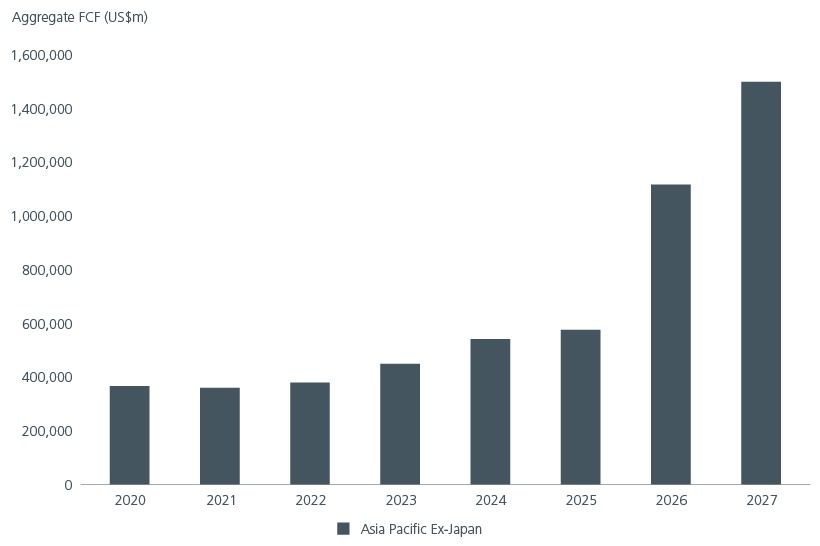
Source: Eastspring Investments. CLSA Asia Pacific Ex-Japan Universe. 6 October 2026.
No need to choose between income and growth
A conventional high-dividend strategy may struggle during a growth-led market rally as screening primarily for the highest current yields tends to favour mature businesses and value-oriented sectors, while excluding companies that are reinvesting in emerging growth opportunities.
However, by combining stable dividend yielders with dividend growers and yields in recovery in a portfolio, we help investors benefit from both income and growth. Often, companies that are dividend growers and yields in recovery tend to benefit from earnings growth and an increasing focus on shareholder return before turning into traditional high yielding stocks.
This approach of looking beyond current yield allowed us to participate in the technology and AI-related opportunities in Taiwan and Korea while maintaining income discipline and avoiding excessive concentration risks. Our objective is not to maximise yield at the expense of growth, or to chase growth at the expense of income. Instead, we aim to achieve a balanced total return profile that combines sustainable income, dividend growth and capital appreciation.
Seeking resilience with an active, style agnostic approach
Traditional dividend equities have often demonstrated defensive characteristics, historically capturing less of the market’s downside. But the same features that provide resilience can also limit participation in rising markets, particularly when portfolios are concentrated in mature, high-yielding value sectors. The issue is not with dividend investing itself but the narrow way in which dividend investing is sometimes implemented.
Our style-agnostic approach seeks to address this by drawing income from different sources. Rather than making a structural bet on value, defensives or growth, we focus on cash flow durability, dividend direction and valuations.
At the same time, dividend categories are not fixed as companies and capital allocation policies evolve. A stable dividend payer may become a dividend grower while a recovering business may eventually mature to provide a stable source of income. Active dividend investing is therefore necessary to capture the opportunities that arise from companies’ dynamic dividend lifecycles.
Interesting reads









This document is produced by Eastspring Investments (Singapore) Limited and issued in:
Singapore by Eastspring Investments (Singapore) Limited (UEN: 199407631H)
Australia (for wholesale clients only) by Eastspring Investments (Singapore) Limited (UEN: 199407631H), which is incorporated in Singapore, is exempt from the requirement to hold an Australian financial services licence and is licensed and regulated by the Monetary Authority of Singapore under Singapore laws which differ from Australian laws
Hong Kong by Eastspring Investments (Hong Kong) Limited and has not been reviewed by the Securities and Futures Commission of Hong Kong.
Indonesia by PT Eastspring Investments Indonesia, an investment manager that is licensed, registered and supervised by the Indonesia Financial Services Authority (OJK).
Malaysia by Eastspring Investments Berhad (200001028634/ 531241-U) and Eastspring Al-Wara’ Investments Berhad (200901017585 / 860682-K) and has not been reviewed by Securities Commission of Malaysia.
Thailand by Eastspring Asset Management (Thailand) Co., Ltd.
United States of America (for institutional clients only) by Eastspring Investments (Singapore) Limited (UEN: 199407631H), which is incorporated in Singapore and is registered with the U.S Securities and Exchange Commission as a registered investment adviser.
European Economic Area (for professional clients only) and Switzerland (for qualified investors only) by Eastspring Investments (Luxembourg) S.A., 26, Boulevard Royal, 2449 Luxembourg, Grand-Duchy of Luxembourg, registered with the Registre de Commerce et des Sociétés (Luxembourg), Register No B 173737.
Chile (for institutional clients only) by Eastspring Investments (Singapore) Limited (UEN: 199407631H), which is incorporated in Singapore and is licensed and regulated by the Monetary Authority of Singapore under Singapore laws which differ from Chilean laws.
The afore-mentioned entities are hereinafter collectively referred to as Eastspring Investments.
The views and opinions contained herein are those of the author, and may not necessarily represent views expressed or reflected in other Eastspring Investments’ communications. This document is solely for information purposes and does not have any regard to the specific investment objective, financial situation and/or particular needs of any specific persons who may receive this document. This document is not intended as an offer, a solicitation of offer or a recommendation, to deal in shares of securities or any financial instruments. It may not be published, circulated, reproduced or distributed without the prior written consent of Eastspring Investments. Reliance upon information in this document is at the sole discretion of the reader. Please carefully study the related information and/or consult your own professional adviser before investing.
Investment involves risks. Past performance of and the predictions, projections, or forecasts on the economy, securities markets or the economic trends of the markets are not necessarily indicative of the future or likely performance of Eastspring Investments or any of the funds managed by Eastspring Investments.
Information herein is believed to be reliable at time of publication. Data from third party sources may have been used in the preparation of this material and Eastspring Investments has not independently verified, validated or audited such data. Where lawfully permitted, Eastspring Investments does not warrant its completeness or accuracy and is not responsible for error of facts or opinion nor shall be liable for damages arising out of any person’s reliance upon this information. Any opinion or estimate contained in this document may subject to change without notice.
Eastspring Investments companies (excluding joint venture companies) are ultimately wholly owned/indirect subsidiaries of Prudential plc of the United Kingdom. Eastspring Investments companies (including joint venture companies) and Prudential plc are not affiliated in any manner with Prudential Financial, Inc., a company whose principal place of business is in the United States of America or with the Prudential Assurance Company Limited, a subsidiary of M&G plc (a company incorporated in the United Kingdom).