








Hi, how can I assist?
Give me a summary of the article
Edge AI is emerging as the next phase of AI adoption, bringing intelligence closer to where data is generated and decisions are made.
Growing inference workloads, automation trends and demand for real-time processing are supporting rapid growth in edge AI.
Asia’s leadership across the edge AI value chain creates compelling investment opportunities as AI adoption expands into everyday devices and machines.
The Artificial Intelligence (AI) story is no longer confined to data centres and cloud infrastructure. Increasingly, AI is being embedded into everyday devices and machines. This is driving the rise of edge AI, which brings computing closer to where data is generated, enabling faster, more responsive applications.
From smartphones and laptops to industrial equipment and autonomous systems, edge AI allows devices to process data locally and act in real time. As a result, real-world systems are becoming smarter, more efficient, and increasingly automated.
While edge AI is well suited to applications that require real-time decisions and local processing, the cloud continues to provide the scale, storage and computational power needed to train and deploy increasingly sophisticated AI models. Rather than replacing the cloud, edge AI extends its capabilities, with both cloud and edge working together to support a growing range of AI applications.
What are the growth drivers of edge AI?
Beyond reducing latency, edge AI can improve reliability in environments where connectivity is limited, while keeping sensitive consumer and government data closer to its source may strengthen privacy and security. This is becoming more important as AI regulation evolves. Cost is another important consideration. Not every AI task requires the computing power of a data centre, and running smaller models directly on devices can reduce bandwidth requirements, lower power consumption, and improve efficiency.
As the AI market shifts from training to inference, the economics increasingly favour edge AI. Since inference occurs every time AI is used, supporting billions of daily interactions solely through centralised cloud infrastructure becomes increasingly costly. Large scale data centres also require substantial amounts of electricity, water and cooling capacity, raising questions around sustainability and resource efficiency.
The case for edge AI too extends beyond the technology benefits. Structural challenges such as ageing populations, labour shortages and the need for greater productivity are accelerating the adoption of automation across industries. At the same time, data volumes are expanding rapidly, while the sheer number of decisions required is outpacing human capacity to process them. Edge AI helps bridge this gap by enabling devices and machines to analyse information and act autonomously at scale.
Which segment of edge AI is growing rapidly?
Industry forecasts consistently point to strong double-digit growth for edge AI. Supporting this trend, International Data Corporation (IDC) projects global spending on edge computing solutions to reach US$261 billion in 2025 and rising to US$380 billion by 2028. This growing investment in edge infrastructure is expected to provide a foundation for the wider adoption of edge AI applications.
Hardware currently represents the largest share of the edge AI market, driven by growing demand for AI-enabled devices such as smartphones, PCs, smart cameras, industrial robots, sensors, and edge servers. Fig 1. Meanwhile, edge cloud infrastructure is expected to grow the fastest as companies increasingly deploy AI and connect thousands of devices across factories, offices, and other locations.
Fig 1: Global edge AI market size by component (forecast till 2033)
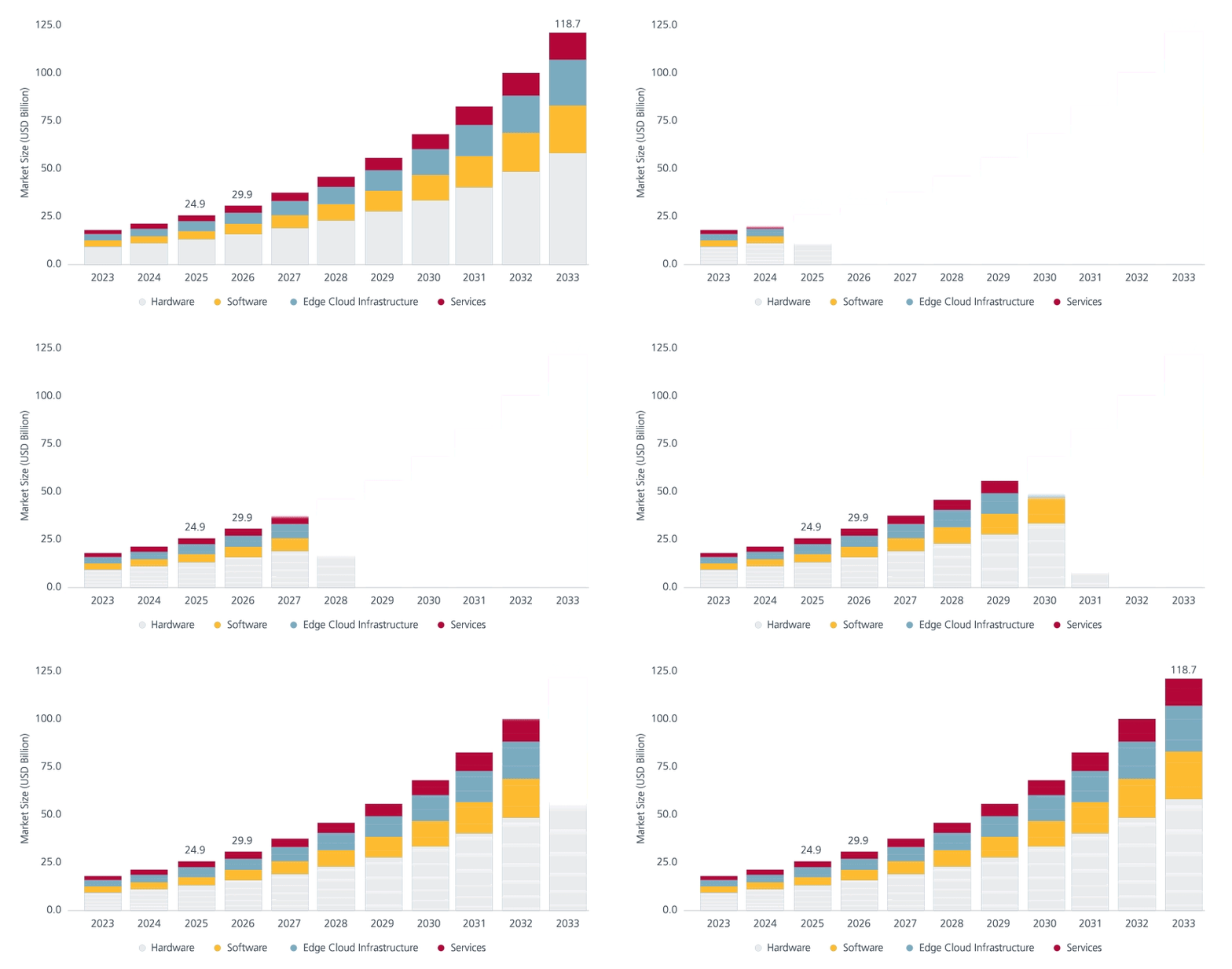
Source: Grandview Research, 2025
Asia is expected to be the fastest-growing edge AI market. The region combines a comprehensive semiconductor and electronics ecosystem with rising adoption across smartphones, vehicles, factories, and telecommunications networks. Continued investment in smart manufacturing, robotics, 5G and connected infrastructure is further accelerating deployment across China, Japan, and South Korea.
What is Asia’s role in edge AI?
Edge AI broadens the AI opportunity set beyond data centres and cloud infrastructure, creating opportunities across the wider technology value chain, including device makers, semiconductor companies, memory suppliers, industrial automation firms, and networking providers.
Asia is uniquely positioned to benefit from edge AI. The region manufactures many of the chips, memory, sensors, and electronic components that enable edge AI, while also representing a major market for smartphones, electric vehicles, industrial automation, and smart manufacturing. Fig 2. This combination of manufacturing strength and end-market demand creates a compelling investment opportunity.
Fig 2: Asia benefits at every stage of the edge AI value chain from components to consumers

Source: Eastspring Investments. July 2026
Today's edge AI applications largely enhance existing devices by making them smarter, faster, and more responsive. However, the next stage of AI evolution goes a step further. Rather than simply assisting users, AI systems will increasingly interact with and act upon in the physical world.
This shift gives rise to physical AI, where robots, autonomous machines and intelligent systems must perceive, reason and act in real time. Such capabilities are only possible because of edge AI. For investors, understanding edge AI is therefore important not only because of its own growth potential, but because it provides the technological foundation for the next phase of the AI revolution.
This article is the fourth in a five‑part series on the AI technology cycle and the investment opportunities in Asia as the cycle evolves and matures. Explore the full series.
Look out for the final article in this tech series, "Why Asia is the investment sweet spot in physical AI", where we explore how edge AI is enabling the rise of robotics and autonomous systems across Asia.
Interesting reads



Singapore by Eastspring Investments (Singapore) Limited (UEN: 199407631H)
Australia (for wholesale clients only) by Eastspring Investments (Singapore) Limited (UEN: 199407631H), which is incorporated in Singapore, is exempt from the requirement to hold an Australian financial services licence and is licensed and regulated by the Monetary Authority of Singapore under Singapore laws which differ from Australian laws
Hong Kong by Eastspring Investments (Hong Kong) Limited and has not been reviewed by the Securities and Futures Commission of Hong Kong.
Indonesia by PT Eastspring Investments Indonesia, an investment manager that is licensed, registered and supervised by the Indonesia Financial Services Authority (OJK).
Malaysia by Eastspring Investments Berhad (200001028634/ 531241-U) and Eastspring Al-Wara’ Investments Berhad (200901017585 / 860682-K).
Thailand by Eastspring Asset Management (Thailand) Co., Ltd.
United States of America (for institutional clients only) by Eastspring Investments (Singapore) Limited (UEN: 199407631H), which is incorporated in Singapore and is registered with the U.S Securities and Exchange Commission as a registered investment adviser.
European Economic Area (for professional clients only) and Switzerland (for qualified investors only) by Eastspring Investments (Luxembourg) S.A., 26, Boulevard Royal, 2449 Luxembourg, Grand-Duchy of Luxembourg, registered with the Registre de Commerce et des Sociétés (Luxembourg), Register No B 173737.
Chile (for institutional clients only) by Eastspring Investments (Singapore) Limited (UEN: 199407631H), which is incorporated in Singapore and is licensed and regulated by the Monetary Authority of Singapore under Singapore laws which differ from Chilean laws.
The afore-mentioned entities are hereinafter collectively referred to as Eastspring Investments.
The views and opinions contained herein are those of the author, and may not necessarily represent views expressed or reflected in other Eastspring Investments’ communications. This document is solely for information purposes and does not have any regard to the specific investment objective, financial situation and/or particular needs of any specific persons who may receive this document. This document is not intended as an offer, a solicitation of offer or a recommendation, to deal in shares of securities or any financial instruments. It may not be published, circulated, reproduced or distributed without the prior written consent of Eastspring Investments. Reliance upon information in this document is at the sole discretion of the reader. Please carefully study the related information and/or consult your own professional adviser before investing.
Investment involves risks. Past performance of and the predictions, projections, or forecasts on the economy, securities markets or the economic trends of the markets are not necessarily indicative of the future or likely performance of Eastspring Investments or any of the funds managed by Eastspring Investments.
Information herein is believed to be reliable at time of publication. Data from third party sources may have been used in the preparation of this material and Eastspring Investments has not independently verified, validated or audited such data. Where lawfully permitted, Eastspring Investments does not warrant its completeness or accuracy and is not responsible for error of facts or opinion nor shall be liable for damages arising out of any person’s reliance upon this information. Any opinion or estimate contained in this document may subject to change without notice.
Eastspring Investments companies (excluding joint venture companies) are ultimately wholly owned/indirect subsidiaries of Prudential plc of the United Kingdom. Eastspring Investments companies (including joint venture companies) and Prudential plc are not affiliated in any manner with Prudential Financial, Inc., a company whose principal place of business is in the United States of America or with the Prudential Assurance Company Limited, a subsidiary of M&G plc (a company incorporated in the United Kingdom).